


What is a Planetary Convergence?
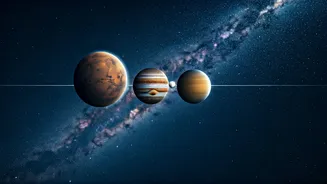
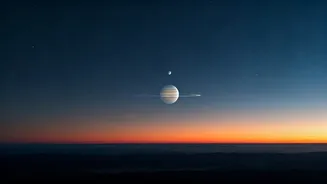
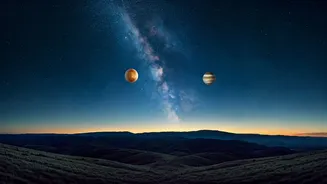
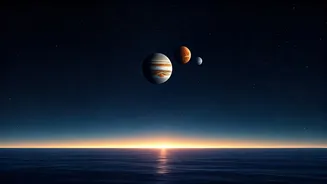
A 'planetary convergence' or 'conjunction' is a beautiful line-of-sight trick. The planets are not actually close to each other in space—they remain millions of kilometres apart on their own orbits. From our perspective on Earth, however, their paths
appear to cross in the sky, making them look like they are huddled together. While two planets meeting is relatively common, seeing three bright planets cluster in the same small patch of sky is a much rarer and more spectacular event. It’s a cosmic coincidence that offers a fantastic opportunity for stargazers to see multiple worlds at once without having to move their telescope or even their gaze.
The Celestial Trio on Display
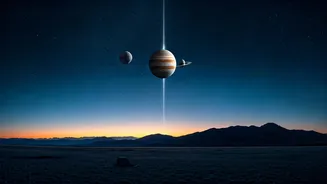
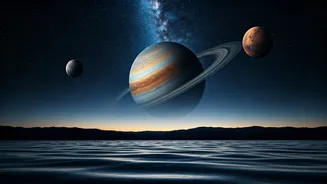
This week's event features a stunning lineup: Jupiter, Mars, and Saturn. Jupiter, the largest planet in our solar system, will shine as the brightest, most unmissable point of light in the trio. Saturn, famous for its rings, will appear slightly dimmer and with a steady, yellowish glow. The unmistakable reddish hue of Mars, our planetary neighbour, will complete the triangle of light. Watching these three worlds dance together in the twilight sky is a reminder of the grand, clockwork-like motion of our solar system. Such gatherings allow us to appreciate the different characteristics of these planets in a single view.
When and Where to Look
The best time to view this celestial gathering is in the hour right after sunset. As the sky darkens from blue to deep indigo, the planets will emerge. You should be looking towards the western horizon, the same direction the sun just set. The planets will appear as bright, star-like objects that don’t twinkle as much as actual stars. To get the best view, find a location with an unobstructed view of the west, away from tall buildings or trees. The convergence will be visible for several evenings, but it will be at its most compact—and arguably most impressive—tonight. So, don't miss the peak alignment!
Naked Eye, Binoculars, or Telescope?
The good news is that this event is accessible to everyone, regardless of equipment.
**Naked Eye:** Jupiter, Mars, and Saturn are all bright enough to be easily seen with the naked eye, even from moderately light-polluted areas. You will be able to clearly distinguish the three points of light and their tight formation.
**Binoculars:** A standard pair of binoculars (like 7x50 or 10x50) will elevate your experience significantly. They will gather more light, making the planets appear brighter and more vivid in colour. You might even be able to spot Jupiter's four largest moons—Io, Europa, Ganymede, and Callisto—appearing as tiny pinpricks of light lined up beside the planet.
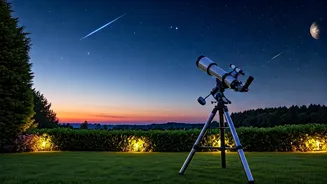
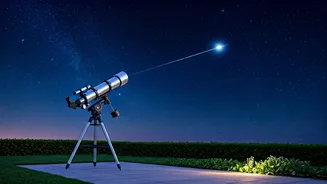
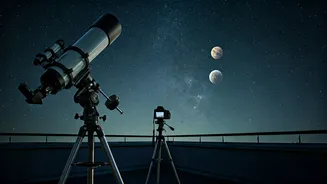
**Telescope:** If you have a telescope, you are in for a real treat. A small telescope will resolve Saturn's rings, turning the planet from a point of light into a distinct oval shape. You will also get a much clearer view of Jupiter’s moons and perhaps even a hint of its cloud belts. The joy of a telescope is being able to frame all three planets in a low-power eyepiece, a truly rare and memorable sight.
Tips for Urban Stargazers
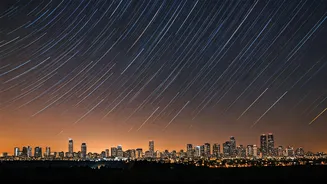
Living in a big city like Delhi, Mumbai, or Bengaluru doesn't mean you have to miss out. While light pollution is a challenge, bright planets can cut through the haze. The key is to minimise direct glare. Try to find a park, a rooftop, or a balcony that faces west and is shielded from nearby streetlights. Give your eyes at least 15 minutes to adjust to the darkness; this will help you spot the dimmer planets and surrounding stars more easily. Using an app like Stellarium or SkyView on your phone can also be a massive help—you can point it at the sky, and it will identify the planets for you, confirming you're looking in the right spot.