






It's All About the Aperture
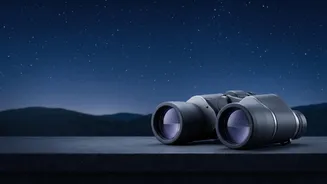
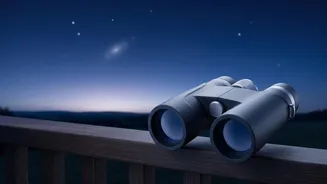
The primary job of any astronomical instrument isn't just to magnify, but to make dim objects brighter. This is where aperture comes in. The second number on a pair of binoculars, like the '50' in 10x50, represents the diameter of the large front lenses
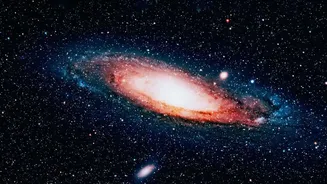
in millimeters. Think of these lenses as light buckets. The larger the diameter, the more light they can collect from a faint, faraway object. Your eye's pupil, even when fully dilated in the dark, is only about 7mm wide. A 50mm binocular lens has a surface area many times larger, allowing it to capture a flood of photons that your eye would miss entirely. This concentrated light is what turns a patch of seemingly empty sky into a visible, fuzzy glow that might be a nebula or a galaxy millions of light-years away.
The Role of Magnification
Magnification, the first number in '10x50', certainly plays a role, but perhaps not in the way you'd expect. While making an object appear ten times closer sounds like the main goal, its real benefit for faint objects is darkening the background sky. By spreading the light of the sky over a larger apparent area, the contrast between your target and its surroundings increases. This makes it easier to pick out a dim galaxy from the skyglow, especially in areas with some light pollution. However, there's a trade-off. Higher magnification also amplifies the natural shake of your hands and narrows your field of view, which can make finding and tracking objects more difficult. For sweeping through the Milky Way or viewing large clusters, a lower magnification like 7x or 8x is often preferred for its stability and wider perspective.
Matching Light to Your Eye
Gathering all that light is pointless if it doesn't efficiently enter your eye. This is where a concept called the 'exit pupil' becomes critical. The exit pupil is the small circle of light you can see in each eyepiece if you hold the binoculars away from your face. Its diameter is calculated by dividing the aperture by the magnification. For example, 10x50 binoculars have an exit pupil of 5mm (50 ÷ 10). For the brightest possible image at night, you want this beam of light to be roughly the same size as your eye's fully dilated pupil, which is typically 5-7mm. If the exit pupil is much smaller, the image will appear dim. If it's much larger, some of the collected light will be wasted as it falls on your iris instead of passing through your pupil. This is why classic astronomy binoculars like 7x50s, with their large 7.1mm exit pupil, are so effective in the dark.
Two Eyes Are Better Than One
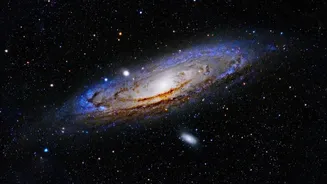
A key advantage of binoculars over a standard telescope is the use of both eyes. This isn't just about comfort; it provides a tangible improvement in what you can see. Viewing with two eyes, a practice known as binocular vision, increases your ability to detect low-contrast details and can provide a subtle, almost three-dimensional feeling to the view. Your brain combines the input from both eyes, effectively enhancing the signal and reducing perceived image noise. This biological advantage means you can often spot fainter objects with two 50mm lenses in a binocular than you could with a single 50mm lens in a telescope. This makes binoculars perfect for observing large, sprawling objects like the Andromeda Galaxy or the Pleiades star cluster, which often fit perfectly within their wide field of view.