

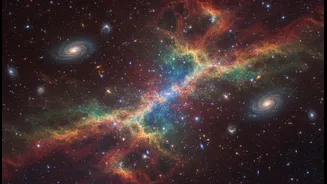


A Cosmic Crash in Delphinus
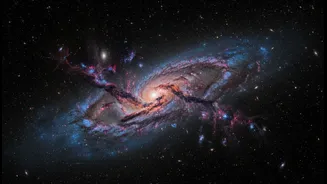
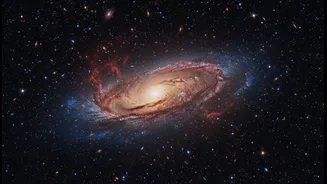
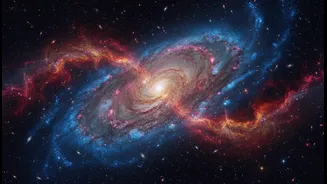
The subject of Webb's latest portrait is a galactic merger known as II Zwicky 96. Located about 500 million light-years away in the constellation Delphinus, this system is a jumble of two galaxies that have begun an irreversible cosmic collision. In images
from telescopes that see visible light, like the Hubble Space Telescope, the most fascinating parts of the merger are obscured by thick clouds of cosmic dust. But for the James Webb Space Telescope, this dust is not a barrier; it's a doorway. The system is classified as a Luminous Infrared Galaxy (LIRG), meaning it is exceptionally bright in infrared light, making it a perfect target for Webb. The collision has triggered a furious burst of star formation, a so-called "starburst" that generates immense energy, but most of it has been hidden until now.
Webb's Infrared Superpower
So, how does Webb see what other telescopes cannot? The answer lies in its ability to detect infrared light. Cosmic dust, which is more like smoke than the dust bunnies under your bed, effectively blocks shorter wavelengths of light, including the visible light our eyes can see. Trying to see into a dusty nebula with a regular telescope is like trying to see through a smoke-filled room. However, longer wavelengths of light, such as infrared, can pass through this dust more easily. Webb’s massive, gold-coated mirror is specifically designed to collect this infrared light. By doing so, it lifts the dusty curtain, allowing astronomers to peer directly into the heart of cosmic nurseries and chaotic events like the II ZW 96 merger, revealing the processes happening within.
What the Dust Was Hiding
With its Near-Infrared Camera (NIRCam) and Mid-Infrared Instrument (MIRI), Webb has unveiled the spectacular details at the core of the collision. The images reveal bright tendrils connecting the two galactic cores, which are themselves ablaze with activity. These tendrils are enormous star-forming regions, sparked into life by the gravitational chaos of the merger. The images are so detailed that they show how the spiral arms of the lower galaxy have been violently twisted out of shape. The most luminous part of the system is a compact, off-nuclear starburst region that is responsible for a huge portion of the system's total infrared light. This star factory is producing new stars at a rate many times faster than our own Milky Way galaxy.
A Window into Galaxy Evolution
Observing systems like II ZW 96 is not just about capturing stunning images. These observations are a crucial window into how galaxies grow and evolve over billions of years. Galaxy mergers are a fundamental process in the universe, often leading to periods of rapid growth and change. The intense starburst in II ZW 96 is thought to be a relatively short-lived phase in astronomical terms. By studying the age of the star clusters and the structure of the gas and dust, scientists can piece together the timeline of the collision. This helps them test and refine their models of star formation in extreme environments, providing insights that can be applied to understanding the early universe, when such mergers and starbursts were much more common.