





A Climate Archive at the Bottom of a Lake
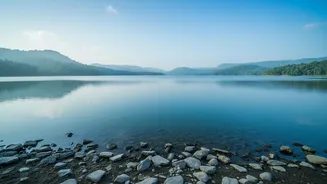
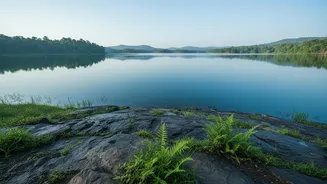
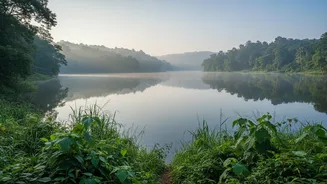
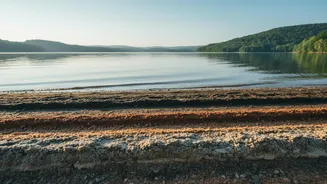
In the Korba district of Chhattisgarh, scientists from the Birbal Sahni Institute of Palaeosciences (BSIP) have uncovered a remarkable story hidden in plain sight. At the bottom of Raja Rani Lake, they found a natural archive preserving 2,500 years of environmental
history. By carefully extracting a 40-centimetre-long core of sediment, the researchers accessed a layer-by-layer account of the region's past. This location is particularly significant as it sits within India's Core Monsoon Zone (CMZ), the belt that receives the vast majority of the country's annual rainfall and is highly sensitive to changes in the monsoon’s behaviour.
The Science of Reading Pollen
The key to deciphering this climate history lies in a field called palynology—the study of pollen grains. Plants release enormous amounts of pollen, which settles on the ground and in bodies of water. In the oxygen-poor environment of a lakebed, these microscopic grains can be preserved for millennia. Different plants produce unique pollen, so by identifying the types of pollen in each sediment layer, scientists can reconstruct the surrounding vegetation. For instance, an abundance of pollen from forest-loving plants suggests a warm and wet climate, while pollen from grasses and herbs points to drier conditions. This allows the sediment core to be read like a book, with each page revealing what the landscape and climate looked like at a specific point in time.
A Surprisingly Strong Ancient Monsoon
The study’s most striking finding rewrites a key chapter of India's climate history. The pollen records show that between roughly 1060 and 1725 CE, the Indian Summer Monsoon was significantly stronger and more intense than previously believed. During this period, the pollen analysis revealed a landscape dominated by dense mixed tropical deciduous forests, indicating a consistently warm and humid climate with heavy rainfall. This era coincides with a global climatic event known as the Medieval Climate Anomaly, a time of warmer global temperatures. The researchers suggest this intensified monsoon was driven by a combination of factors, including La Niña-like conditions in the Pacific and increased solar activity.
Why Ancient Weather Matters Now
Understanding what the monsoon was doing a thousand years ago may seem like a purely academic exercise, but it has profound implications for India’s present and future. Climate models are our primary tool for predicting the future of the monsoon in a warming world. These models work best when they are tested against real-world data from the past. This study provides a crucial benchmark for how the monsoon system behaves during natural warm periods, free from modern industrial influence. By revealing the full range of the monsoon's natural variability—including its capacity for much stronger phases—this research helps scientists refine their models, leading to more accurate predictions about future rainfall patterns, droughts, and floods.