




Understanding the Monsoon River
During the monsoon, Meghalaya’s rivers are not just flowing bodies of water; they are powerful, unpredictable forces of nature. The region receives some of the highest rainfall on Earth, which can cause river levels to rise dramatically in minutes, creating
flash flood conditions. This high volume of water, known as 'big water' in kayaking circles, creates powerful hydraulics, boils, and whirlpools that can easily trap an unsuspecting paddler. The water is often murky, hiding hazards like submerged boulders, logs, and other debris. Unlike clearer, lower-volume rivers, what you see on the surface is only a fraction of the story. The sheer force of the current means that a simple mistake can have severe consequences, making it an environment suitable only for expert kayakers with specific high-volume experience.
The Non-Negotiable Combat Roll
In the chaotic environment of a monsoon-swollen river, flipping over is not a matter of if, but when. The ability to perform a 'combat roll'—a fast, reliable roll executed under pressure in turbulent water—is the most fundamental survival skill. There is no time to wait for a rescue in such powerful currents. A failed roll attempt can lead to a long, dangerous swim through rapids, risking impact with rocks or entrapment. Before even considering a high-volume course, a kayaker must have a bombproof roll that works on both sides, in aerated water, and when disoriented. Practicing in moving water and varied conditions until the roll becomes an automatic reflex is critical. Without it, you are a liability to yourself and your entire team.
Reading the River's Language
High-volume rivers speak a different language. The familiar eddies and clear lines of a low-water run can disappear, replaced by massive wave trains, chaotic boils, and powerful eddy lines that can feel like a wall. The key survival skill here is proactive, not reactive, river reading. This means identifying safe zones and potential hazards far in advance. Kayakers must learn to spot the subtle signs of danger: a 'strainer' (a tree or obstacle that allows water to pass through but not a person), an 'undercut' rock where water flows underneath with immense force, or a 'hole' that can hold a kayak indefinitely. The goal is to connect the green tongues of smooth water, using the river's features to your advantage rather than fighting them. This requires constant focus and the ability to make split-second decisions.
Mastering Swiftwater Rescue
Even with expert skills, things can go wrong. This is where swiftwater rescue training becomes invaluable. Every member of a kayaking team must be proficient in both self-rescue and rescuing others. This goes beyond the basic T-rescue. It involves the correct use of throw ropes, understanding how to set up vector pulls to unpin a trapped boat, and knowing how to safely approach a swimmer in a fast-moving current. One of the most dangerous situations is a foot entrapment, where a person's foot gets wedged in the riverbed. Knowing not to stand up in a strong current is a primary rule. Rescue skills are a team responsibility; paddling in such conditions without a group of trusted, trained partners is an unacceptable risk.
Your Gear is Your Lifeline
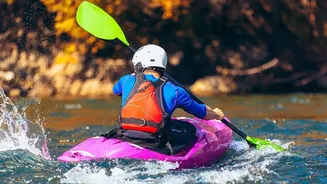
In extreme whitewater, your equipment is not for comfort; it is essential survival gear. A high-quality, properly fitting helmet and a personal flotation device (PFD) with high buoyancy are mandatory. A reliable spray skirt that won't implode under the force of a wave is also crucial. Every kayaker should carry a throw rope and a river knife accessible on their PFD. The knife is not for defence, but to cut a rope in an emergency entanglement situation. The right boat, typically a creek boat or half-slice designed for river running, provides the stability and volume needed to punch through large features. Clothing like a dry suit or appropriate layers is needed to prevent hypothermia, which can set in quickly even in a tropical climate.
The Crucial Human Element
Beyond technical skills and gear lies the most important factor: judgment. This includes knowing your own limits and being honest about your abilities. It also involves seamless teamwork and communication. Hand signals and whistle commands are essential when verbal communication is impossible over the roar of the river. Crucially, all adventure sports in Meghalaya's monsoon conditions should be undertaken with certified local guides. These guides possess intimate knowledge of the rivers, weather patterns, and flash flood risks that can be the difference between a thrilling adventure and a tragedy. They know which sections are safe to run and, more importantly, when to walk away.