




The Monsoon Problem for Solar Power
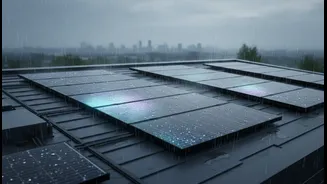
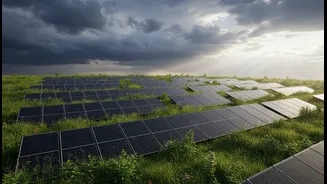
India has made massive strides in solar energy, blanketing rooftops and vast fields with photovoltaic panels. Yet, for several months each year, the monsoon rolls in, bringing with it thick clouds and relentless rain. During this season, solar energy generation
can dip significantly. Conventional solar panels work best under direct, bright sunlight. On heavily overcast days, their output can drop to just 10-25% of their rated capacity. This variability is a major hurdle for a national grid that depends on a consistent power supply. The high humidity and moisture also pose long-term challenges, increasing the risk of corrosion and electrical faults in solar installations if they are not adequately protected.
Enter Ultra-Thin Solar Sheets
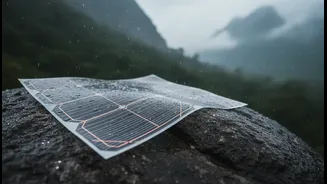
Imagine a solar cell thinner than a human hair, flexible enough to wrap around a curved surface, and light enough to be integrated into clothing or vehicles. This is the world of ultra-thin solar cells. Unlike traditional rigid panels made from crystalline silicon, these next-generation sheets are often built from different materials like perovskites, organic polymers, or amorphous silicon. Their key advantage isn't just their form factor. Many of these materials are better at absorbing a broader spectrum of light, which allows them to perform more efficiently in low-light and diffuse light conditions — exactly the kind of light that dominates on a cloudy day.
Power from Sunlight and Raindrops
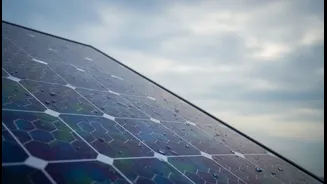
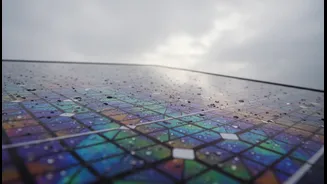
The most revolutionary concept is the development of hybrid panels that can generate electricity from both sunlight and the impact of raindrops. Researchers have been developing solar cells with an added transparent layer called a triboelectric nanogenerator, or TENG. This layer creates a small electric charge through friction when raindrops strike its surface. While a solar cell converts photons into electricity, the TENG converts the kinetic energy of falling rain into usable power. This means a single panel could offer a dual benefit: capturing solar energy when the sun is out and harvesting energy from rainfall during a downpour, or even at night. Prototypes have demonstrated the ability to generate significant voltage from a single raindrop, hinting at a future where solar installations never truly go dormant.
The Perovskite Promise
Much of the excitement around next-generation solar, including thin-film applications, centers on perovskites. These materials have a crystal structure that is exceptionally good at absorbing light and converting it to electricity, with lab efficiencies rapidly catching up to and even exceeding traditional silicon. Teams in India, including at IIT Bombay, are actively developing perovskite-based cells, achieving high efficiencies in tandem with silicon. Their excellent performance in low-light conditions makes them a prime candidate for climates with significant cloud cover. Furthermore, they can be manufactured at lower costs, potentially making solar energy more affordable and accessible.
A Reality Check: Hurdles on the Horizon
Despite the immense potential, ultra-thin and perovskite solar cells are not yet ready to replace every silicon panel. The biggest challenge is durability. Many of these advanced materials, particularly perovskites and organic polymers, are sensitive to moisture, oxygen, and high temperatures, causing them to degrade much faster than traditional panels. While a standard silicon panel can last 25-30 years, early-stage organic cells may have a lifespan of only a few years, or even less when exposed to the elements without robust protection. Researchers are working on better encapsulation techniques and more stable chemical formulas, but scaling up production from small lab samples to large, durable, and cost-effective commercial panels remains a significant engineering obstacle.