



A Panoramic Window on the Universe
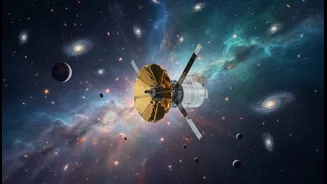
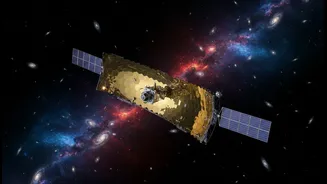
Set to launch as early as August 2026, the Nancy Grace Roman Space Telescope is frequently compared to its famous predecessor, the Hubble Space Telescope. While it has the same size primary mirror—2.4 meters across—its power lies in its radically different
perspective. Roman’s Wide Field Instrument can see a patch of sky at least 100 times larger than Hubble’s infrared camera can in a single snapshot. Imagine taking a picture of the Andromeda galaxy. Where Hubble would need hundreds of individual shots pieced together to map our galactic neighbor, Roman could do it in just two. This ability to conduct vast, high-resolution surveys at incredible speed is what makes Roman a game-changer. It’s shifting the approach from staring intently at one cosmic tree to mapping the entire forest.
Illuminating Invisible Dark Matter
One of astronomy’s biggest puzzles is dark matter, the invisible substance that makes up about 85% of the matter in the universe. We know it's there because of its gravitational pull, but we can't see it directly. Roman will map dark matter's influence on an unprecedented scale. It will do this by studying a phenomenon called gravitational lensing, where the gravity of a massive object, like a galaxy cluster and its associated dark matter, bends and distorts the light from more distant galaxies behind it. Roman’s wide, sharp vision will allow it to spot tens of thousands of these cosmic lenses. By analyzing the subtle distortions in the shapes of millions of galaxies, scientists can create a detailed map showing where dark matter is hiding, helping to test our fundamental models of how the universe is structured.
A Galactic Census of New Worlds
While telescopes like Kepler found thousands of planets by watching for the dip in starlight as a planet passes in front of its star (the transit method), Roman will primarily use a different technique called gravitational microlensing. This method can detect planets at much greater distances, including worlds that are rocky and small like Earth, ice giants like Neptune, or even rogue planets that drift through space without a host star. Microlensing occurs when a star with a planet passes in front of a more distant star, and its gravity briefly acts like a lens, magnifying the background starlight. The planet adds its own tiny, characteristic blip to the signal. Roman will stare at the dense starfields at the heart of our Milky Way, and it's expected to discover thousands of new exoplanets, potentially finding more planets than all other telescopes combined. This will provide a true statistical census of the planets in our galaxy.
Mapping the Cosmos in 3D
Beyond our immediate galactic neighborhood, Roman will undertake colossal galaxy surveys to tackle the mystery of dark energy—the force thought to be causing the universe’s expansion to accelerate. By mapping the positions of hundreds of millions of galaxies across cosmic time, the telescope will create the largest-ever 3D map of the universe. This map will allow scientists to see how the distribution of galaxies has evolved and how the tug-of-war between the gravity of dark matter and the push of dark energy has played out over billions of years. These measurements will help refine our understanding of dark energy's properties with 10 times more precision than current methods, potentially revealing whether our understanding of gravity or the universe itself needs a rewrite.