



A Promising New World
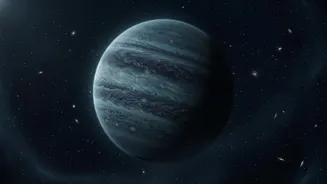
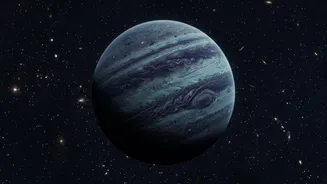
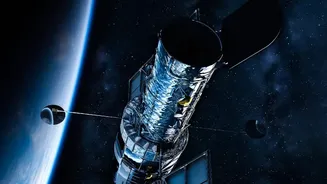
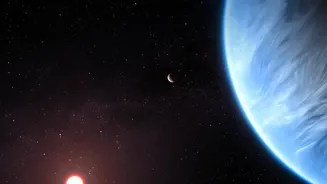
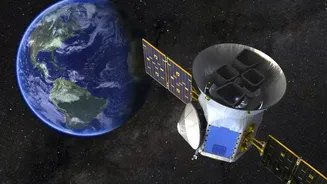
The story began in 2019. Data from NASA's Transiting Exoplanet Survey Satellite (TESS) revealed a faint, periodic dip in the light from a distant star. This is the hallmark of the 'transit method'—the tiny eclipse caused by a planet passing in front of its
star from our point of view. The signal, logged as TESS Object of Interest (TOI) 2535 b, looked promising. It was consistent, repeating on a predictable schedule, suggesting a planet dutifully orbiting its sun. For astronomers, this was the initial spark of discovery, the first clue in a long detective story. A TOI designation is not a confirmation but a starting point; it means 'here is something worth a closer look'. TOI-2535 b was officially a candidate, joining thousands of others that require rigorous follow-up to earn the title of 'confirmed planet'.
The Long Road of Confirmation
Finding a candidate planet is just step one. The real work, which stretched from 2019 into the mid-2020s, is in the verification. This process is a critical piece of due diligence in the business of astronomy. Scientists around the world trained ground-based telescopes on the star, hoping to recapture the transit and gather more data. They also employed other detection techniques, chief among them the 'radial velocity' method. This technique looks for the gravitational 'wobble' a planet induces in its host star. A confirmed transit tells you a planet's size, while a confirmed wobble can tell you its mass. Together, they paint a picture of the world's density and its potential nature. For years, however, the evidence for TOI-2535 b remained frustratingly incomplete. While some observations seemed to corroborate the transit, the crucial radial velocity signal—the gravitational tug—never clearly materialized. The planet's pull was a ghost in the machine.
Cracks in the Facade
By 2025, the case for TOI-2535 b was starting to weaken. The more scientists looked, the more puzzling the signal became. High-resolution imaging and meticulous analysis of the star's light curve—the graph of its brightness over time—began to suggest an alternative explanation. The shape of the dip in starlight was subtly wrong. A planet transit typically creates a flat-bottomed, 'bucket-shaped' light curve. The signal from TOI-2535 b, under intense scrutiny, looked more 'V-shaped'. This is often a tell-tale sign of an eclipsing binary star system—two stars orbiting each other—masquerading as a planet. The large pixels of survey telescopes like TESS can sometimes blend the light of a bright foreground star with a fainter eclipsing binary in the background, creating a diluted signal that perfectly mimics a small planet.
Solving the Case of the Missing Planet
In 2026, the final verdict arrived. After seven years of observation and analysis, an international team concluded that TOI-2535 b was not a planet. It was a 'false positive,' a cosmic impostor. The culprit was precisely what the V-shaped light curve suggested: a faint, background eclipsing binary star system. Its eclipses, blended with the light of the much brighter target star, created the illusion of a transiting world. These false positives are common in exoplanet searches, and weeding them out is a primary objective of the follow-up process. Far from being a failure, this reclassification was a triumph of the scientific method. It demonstrated the system's ability to self-correct and withstand rigorous scrutiny, ensuring that the catalog of confirmed exoplanets is as robust as possible. Every false positive identified makes astronomers more confident in the planets that are validated.
Why 'Lost' Planets Are a Scientific Win
The story of TOI-2535 b highlights a crucial aspect of the technology and business of modern astronomy. In an era where we have discovered thousands of exoplanets, quality control is paramount. Each candidate requires a significant investment of resources, from time on multi-million dollar telescopes to the countless hours of human analysis. Ruling out a candidate like TOI-2535 b is not a loss; it is a critical return on that investment. It refines the detection pipeline, improves the statistical models used to hunt for planets, and sharpens the very techniques astronomers rely on. By understanding how impostors can trick our instruments, we get better at spotting them in the future. In the search for other worlds, knowing where the planets are not is just as important as knowing where they are.