


A Galaxy with a Peculiar Past
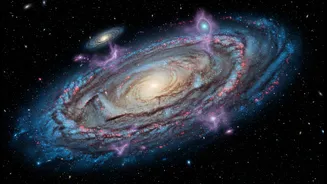
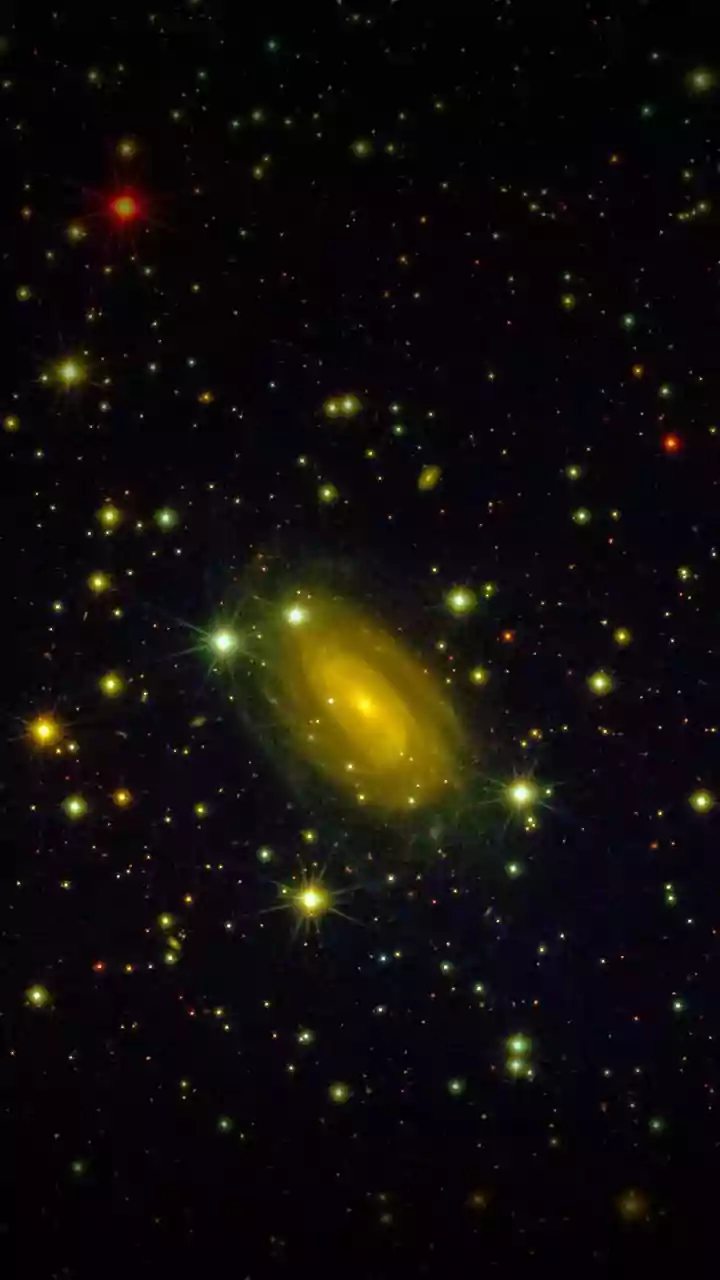
At first glance, Centaurus A looks like a giant, calm elliptical galaxy, a smooth ball of older, reddish stars. But a dark, dramatic slash of dust cuts right across its middle, a feature not typically seen in such galaxies. This strange appearance led
astronomers to classify it as a 'peculiar galaxy' long ago. Scientists now have strong evidence that this peculiarity is the result of a colossal cosmic collision. The prevailing theory is that about two billion years ago, a large elliptical galaxy devoured a smaller, gas-rich spiral galaxy. The dusty band we see today is the mangled, warped remains of that spiral galaxy, offering a snapshot of one of the most transformative events in the universe: a galactic merger.
The Violent Heart of the Matter
At the centre of Centaurus A lurks a supermassive black hole, estimated to have a mass of about 55 to 100 million times that of our Sun. This isn't a quiet black hole; it's an Active Galactic Nucleus (AGN), meaning it is actively feeding on gas and dust falling into it. As material swirls towards the point of no return, it releases tremendous amounts of energy, making Centaurus A the closest active galaxy to Earth. This process is so powerful that it launches two opposing jets of high-energy particles that travel at nearly half the speed of light. These relativistic jets are invisible to the naked eye but glow brightly in radio and X-ray light, stretching over a million light-years into space—far beyond the visible confines of the galaxy itself.
A Nursery for New Stars
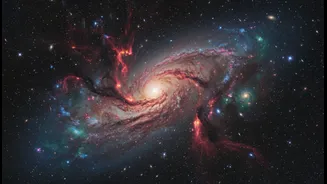
The same dusty debris from the past collision that fuels the central black hole also serves another, more creative purpose. This thick band of gas and dust is a fertile ground for star birth. Shockwaves from the galactic merger compressed vast clouds of hydrogen gas, triggering an intense burst of star formation known as a starburst. Hidden within the dark lanes, powerful telescopes like the Hubble and James Webb Space Telescopes have revealed vibrant clusters of hot, young, blue stars. These new stars illuminate the edges of the dust lane with a brilliant glow, standing in stark contrast to the older, redder stars of the original elliptical galaxy. This makes Centaurus A a rare and valuable laboratory for studying how galactic collisions can trigger new generations of stars.
A Cosmic Laboratory Next Door
The unique combination of these three elements—an active black hole, the remnants of a merger, and ongoing star formation—makes Centaurus A incredibly important to astronomers. It provides a close-up view of the dynamic processes that shape galaxies throughout the universe. The James Webb Space Telescope has recently pierced through the obscuring dust with its infrared vision, revealing the galaxy's core in unprecedented detail and uncovering millions of individual stars and complex, filament-like dust structures. By studying Centaurus A, scientists can investigate how a central black hole influences its host galaxy, sometimes triggering star birth by compressing gas and other times halting it by blasting material away. It’s a living record of cosmic history, a story of destruction and creation playing out on a galactic scale.