

A Familiar End for the Inner Worlds
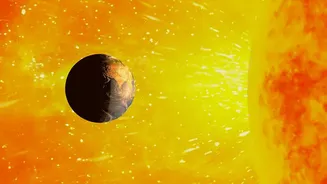
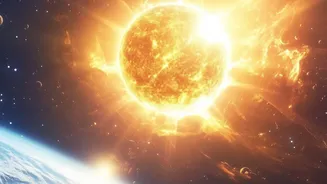
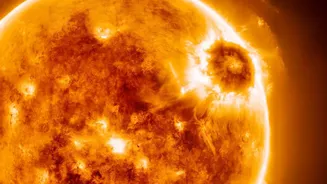
For decades, the accepted script for the solar system’s demise focused on the inner planets. In its final phases, our Sun will exhaust the hydrogen fuel in its core, causing it to expand dramatically. This red giant phase will be catastrophic for its closest
neighbours. The Sun’s outer layers will swell to engulf Mercury and Venus, and likely Earth as well. Even if Earth escapes being swallowed, the intense heat will boil its oceans and strip away its atmosphere, rendering it a scorched, lifeless rock. Mars, while more distant, will face a blistering fate, though it is expected to physically survive the Sun's expansion. This has long been the established, dramatic end to the inner solar system as we know it.
The Great Solar Weight Loss
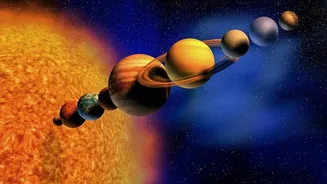
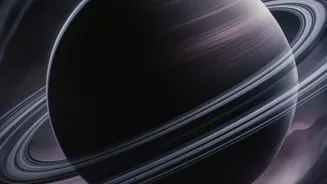
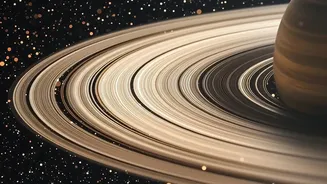
The long-held assumption was that the outer planets—Jupiter, Saturn, Uranus, and Neptune—would be largely unaffected, safe in their distant orbits. While the Sun’s expansion will warm their icy moons, potentially creating temporary water worlds, the planets themselves were thought to be secure. However, the key to their newly questioned fate lies in the Sun’s massive weight loss. As it becomes a red giant and then a white dwarf, the Sun will shed nearly half of its total mass, blowing its outer layers out into space. With significantly less mass, the Sun’s gravitational pull on the remaining planets will weaken considerably.
A New Gravitational Dance
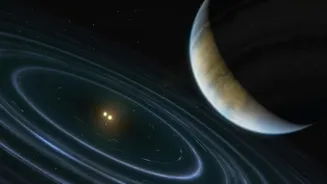
A weaker gravitational grip means the surviving planets will not stay in their current orbits. Instead, their orbits will expand. Imagine swinging a ball on a string and then letting some of the string out; the ball swings in a wider circle. Similarly, Jupiter, Saturn, Uranus, and Neptune will drift into much larger orbits, perhaps twice as far from the Sun’s remnant core as they are today. For a long time, scientists believed this adjustment would be a smooth, stable process, leaving the giant planets to circle a dim white dwarf for trillions of years. New simulations, however, are challenging this peaceful picture.
The Risk of Planetary Pinball
Recent studies suggest the Sun's mass loss won't be a smooth, consistent process. Instead, it may happen in violent, uneven bursts. These ejections would create random gravitational 'kicks' that jolt the Sun and, by extension, the entire planetary system. These repeated kicks could disrupt the delicate gravitational balance that has kept the giant planets in stable orbits for billions of years. New models that simulate these chaotic ejections paint a much more turbulent future. They show that the neatly ordered outer solar system could be thrown into disarray.
What 'Disturbed' Really Means
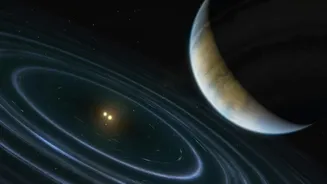
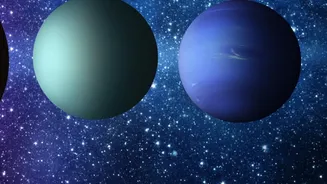
This newfound instability could lead to a variety of chaotic outcomes. In a cosmic game of planetary pinball, the giant planets could start to gravitationally interfere with each other in unpredictable ways. Some simulations show Uranus and Neptune swapping orbits. In more extreme scenarios, one or more of the outer planets could be ejected from the solar system entirely, flung into the cold darkness of interstellar space. According to some models, the timeline for this breakup is drastically shorter than previously thought—shrinking from a potential quintillion years down to just a few billion years after the Sun becomes a white dwarf. Some simulations even show this instability beginning before the Sun has fully completed its red giant phase.