


The Cosmic Fingerprint Kit
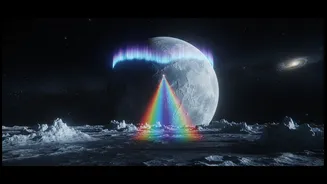
At its heart, spectroscopy is the science of decoding light. Just as a prism splits sunlight into a rainbow, a scientific instrument called a spectrograph does the same for light from distant celestial objects. But it doesn't just create a pretty rainbow;
it reveals a kind of cosmic barcode. Every chemical element and molecule absorbs and emits light at very specific wavelengths. When light from a star reflects off a moon's surface or passes through its thin atmosphere, the materials there leave their unique 'fingerprints' by absorbing certain colours. By analysing which parts of the light spectrum are missing, scientists can determine exactly what the surface or atmosphere is made of, its temperature, and even its density.
Analysing the Crime Scene
The prime suspects in the search for extraterrestrial life are icy moons like Jupiter's Europa and Saturn's Enceladus. Both are thought to hide global liquid water oceans beneath their frozen crusts. Landing a probe there is incredibly difficult, but spectroscopy allows us to be detectives from afar. Telescopes like the James Webb Space Telescope (JWST) can point their powerful spectrographs at these moons and analyse the faint light that bounces off their icy surfaces. Sometimes, these moons even give up their secrets more directly, venting plumes of water vapour and ice grains from their subsurface oceans into space. By analysing the light that passes through these plumes, scientists can get a direct taste of what's in the water without ever touching it.
Major Clues Uncovered
This detective work is already yielding incredible results. Using the JWST, scientists have confirmed the presence of carbon dioxide on the surface of Europa, heavily concentrated in a geologically young area called Tara Regio. The analysis strongly suggests this carbon, a crucial element for life, originates from the ocean below, not from meteorite impacts. In the same 'chaos terrain' region, there is also evidence of sodium chloride—table salt—which hints at a salty ocean interacting with a rocky seafloor, much like on Earth. On Enceladus, re-analysis of data from the Cassini mission has revealed a variety of complex organic molecules, including precursors to compounds essential for life, being ejected in its plumes. These findings don't prove life exists, but they show the necessary ingredients are present.
The Next Generation of Detectives
The investigation is only getting started. While the JWST continues to provide stunning insights from its distant vantage point, a new specialist is on its way to the scene. NASA’s Europa Clipper mission, which is currently en route to Jupiter, is a spacecraft designed specifically for this detective work. It will perform dozens of close fly-bys of Europa, equipped with a powerful suite of instruments, including multiple spectrometers. The Mapping Imaging Spectrometer for Europa (MISE) will map the distribution of ices, salts, and organic materials across the surface. Another, the Europa Ultraviolet Spectrograph (Europa-UVS), will analyse its thin atmosphere and search for active plumes. This mission won't look for life directly, but it will assess Europa's habitability by figuring out the thickness of its ice shell and the composition of its ocean.