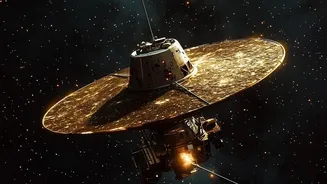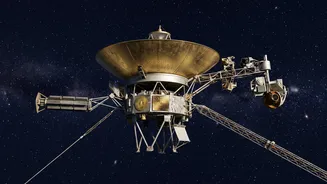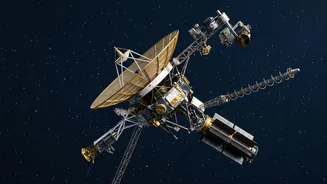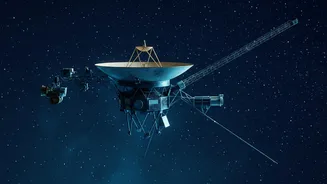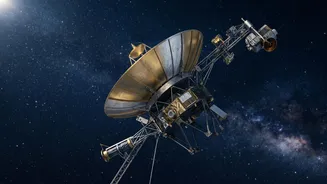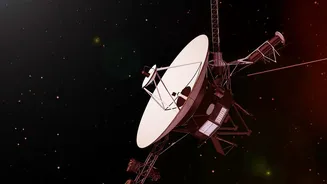




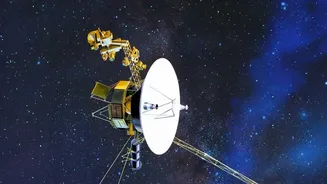
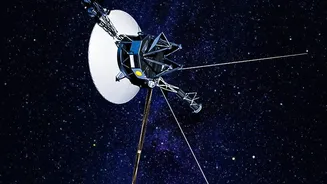
Humanity’s most distant emissary, the Voyager 1 spacecraft, is talking to us again. After a worrying 48-hour silence in October 2026, NASA has confirmed contact, offering a sigh of relief for engineers and space enthusiasts everywhere.
A Sudden, Eerie Silence
On October 18 and
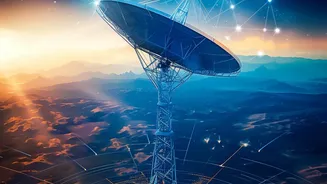
19, 2026, during two scheduled communication sessions, NASA's Deep Space Network received nothing but silence from Voyager 1. For a spacecraft that has been reliably phoning home for nearly 50 years, the sudden quiet was alarming. The probe, now billions of kilometres away in interstellar space, had simply vanished from the network's giant radio antennas. The signal unexpectedly returned on October 20, before engineers on the ground could even send a command to troubleshoot the problem. The spacecraft seemed to have fixed itself, but the mystery of what happened remained.
The Long-Distance Diagnosis
Diagnosing a problem on a 49-year-old spacecraft is a monumental challenge. Voyager 1 is so far away that on November 18, 2026, it will be a full 'light-day' from Earth, meaning a radio signal takes 24 hours to travel one way. A round-trip message, sending a command and receiving a response, takes a minimum of two days. Despite the restored contact, engineers at NASA's Jet Propulsion Laboratory (JPL) dug into the data. They discovered the probe had automatically entered a form of safe mode. One of its thruster groups, which keep the spacecraft oriented correctly, had gone offline, and a backup set had automatically activated as programmed. This fault protection response paused normal operations to give the ground team time to assess the situation.
Keeping a Legend Alive
This recent scare highlights the incredible ingenuity required to keep the Voyager mission going. The spacecraft's nuclear power source, a radioisotope thermoelectric generator, loses about four watts of power each year. To conserve energy, engineers have been making tough decisions, strategically shutting down instruments and heaters. Just weeks before the communication loss, in September 2026, the team performed a major power-saving manoeuvre nicknamed the 'Big Bang'. They swapped three devices for lower-power alternatives, a move designed to extend the life of the remaining science instruments, potentially delaying the next instrument shutdown from 2027. This constant battle against dwindling power and aging hardware is what makes every new signal from the void so precious.
Why Voyager Still Matters
Launched in 1977, Voyager 1 and its twin, Voyager 2, completed a 'Grand Tour' of the outer planets before venturing into uncharted territory. In 2012, Voyager 1 became the first and only human-made object to enter interstellar space, the region between the stars. It is humanity’s farthest pioneer, traveling at over 61,000 kilometres per hour. It carries the famous Golden Record, a gold-plated copper disk containing sounds and images selected to portray the diversity of life and culture on Earth, intended for any intelligent extraterrestrial life that may find it. The data it sends back from beyond our sun's influence continues to provide invaluable insights into the nature of interstellar space. Each day it operates is a bonus for science.