





Get Ready for Stargazing
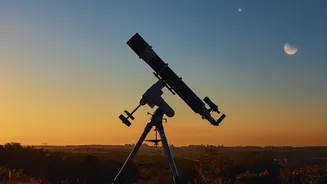
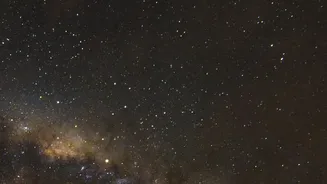
To get the best view, find a spot away from city lights. Give your eyes about 20 minutes to fully adjust to the darkness; this will help you spot fainter stars and meteors. While a telescope isn't necessary, a stargazing app on your phone can be a helpful
guide to orient yourself. Dress warmly, bring a comfortable chair or blanket, and prepare to be amazed by the cosmic display above. The New Moon on October 10 ensures the first half of the month will have especially dark skies, perfect for viewing.
Planets on Parade: Saturn, Jupiter, and Mars
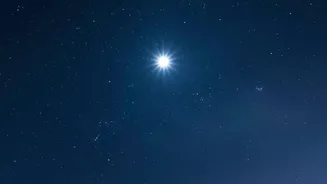
October is a fantastic month for planet-spotting. Saturn is the star of the evening sky, reaching opposition on October 4. This means it's directly opposite the Sun from our perspective, making it visible all night long and brighter than at any other time of the year. Look for it as a steady, pale-yellow light in the eastern sky after sunset. You won't need any equipment to spot this giant. For early risers, Jupiter and Mars are putting on a show in the pre-dawn eastern sky. Jupiter will be a brilliant, unblinking white light, while Mars will appear as a distinct reddish point. The two planets will appear to draw closer throughout the month, offering a beautiful sight for anyone up before sunrise. Venus will be difficult to spot for most observers this month as it stays very low on the western horizon after sunset.
Autumn's Signature Constellations
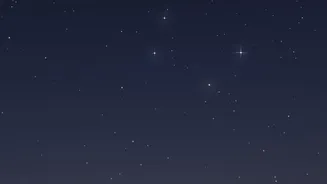
The autumn sky is filled with legendary star patterns. Look high overhead for Cassiopeia, easily identifiable by its distinct 'W' or 'M' shape. Nearby is the Great Square of Pegasus, which forms the body of the mythical winged horse. Using the Great Square as a guide, you can try to spot the Andromeda Galaxy. Under very dark, moonless skies, it appears as a faint, fuzzy patch of light. It’s the most distant object you can see with your naked eye, a staggering 2.5 million light-years away. Another easy-to-spot formation is the 'Summer Triangle', made of the three bright stars Vega, Altair, and Deneb, which remains high in the evening sky.
Catch a 'Shooting Star': Two Meteor Showers
October hosts two meteor showers. First are the Draconids, peaking on the evening of October 8-9. This is an unusual shower because it's best viewed in the evening, right after nightfall, rather than the early morning hours. With the Moon being nearly new, viewing conditions will be excellent. While typically a modest shower with about 5-10 meteors per hour, the Draconids are known for occasional surprise outbursts. Later in the month, the Orionids peak before dawn on October 21-22. These are debris from the famous Halley's Comet. The bright Moon will interfere in the evening, but it sets a few hours before dawn, leaving a window of dark sky for the best viewing. From a dark location, you might see up to 20 fast-moving meteors per hour radiating from the constellation Orion.
The Hunter's Full Moon
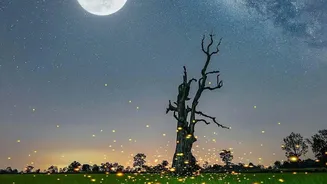
October's full moon, known as the Hunter's Moon, rises on the evening of Sunday, October 25, reaching peak illumination just after midnight on the East Coast. This name traditionally marks the time for hunting in preparation for winter, as the bare fields made animals easier to spot by moonlight. The best time to watch is at moonrise, when it will appear huge and golden-orange on the horizon. You'll find Saturn shining brightly not too far from the full Moon, making for a beautiful celestial pairing.