



Decoding the Visas: Your First Step
For Indian passport holders, navigating Caucasus visas is surprisingly straightforward, thanks to online systems. Georgia requires most Indians to get an e-Visa via the official evisa.gov.ge portal. The process is entirely online, costs around $20, and
typically takes 5-7 working days. However, if you hold a valid visa or residence permit from countries like the US, UK, or any Schengen state, you can enter Georgia visa-free for up to 90 days. For Azerbaijan, a visa is mandatory and there is no visa-on-arrival. The easiest route is the ASAN e-visa system (evisa.gov.az), which provides a single-entry tourist visa valid for a 30-day stay. The process is digital, and you must enter Azerbaijan by air. Armenia also requires a visa, which can be obtained through its e-visa portal (evisa.mfa.am). A 21-day visa costs approximately ₹650. A temporary visa-free policy for some Indians holding valid residence permits from the US, EU, or certain Gulf countries is also in effect for parts of 2026, so check the latest rules before you travel.
Crafting Your Route: Where to Begin?
With visas sorted, your next step is the route. The most critical point to remember is the relationship between Armenia and Azerbaijan: their land border is closed, and you cannot travel directly between them. Any itinerary covering all three countries must transit through Georgia. Furthermore, as of mid-2026, Azerbaijan's land borders remain closed for entry, meaning you must fly into the country, typically to Baku (GYD). You can, however, exit Azerbaijan by land into Georgia. This makes starting your trip in Baku, Azerbaijan, a popular and logical choice. From there, you can travel overland to Georgia and then continue to Armenia before flying out of Yerevan or looping back to Tbilisi.
The Classic Two-Country Loop: Georgia and Armenia
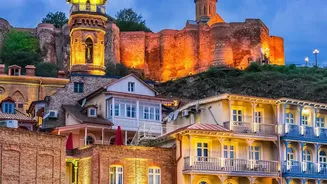
If you have less time or prefer a simpler route, a Georgia-Armenia combination is a fantastic option. Tbilisi, Georgia's capital, serves as an excellent hub. From Tbilisi, you can easily take an overnight train or a marshrutka (minibus) to Yerevan, the capital of Armenia. This journey is well-trodden and straightforward. A popular two-week itinerary would involve flying into Tbilisi, exploring its old town and nearby sights like the ancient capital of Mtskheta, then heading north to the stunning mountain region of Kazbegi. After returning to Tbilisi, you can travel south to Yerevan. In Armenia, you can explore the vibrant 'Pink City', visit ancient monasteries like Khor Virap and Geghard, and relax by the shores of Lake Sevan before returning to Tbilisi for your flight home.
Getting Around on a Budget
The Caucasus is a backpacker's delight when it comes to transport. The most common way to travel between and within cities is by marshrutka. These are shared minibuses that run on set routes but often without fixed schedules, typically leaving when full. They are incredibly affordable, with a journey of several hours costing just a few dollars. In Georgia, the Didube station in Tbilisi is the chaotic but effective hub for marshrutkas heading all over the country. For longer distances, trains are also an option, particularly between major cities like Tbilisi, Batumi, and Yerevan. Ride-sharing apps like Bolt and Yandex are widely available in capital cities and offer a cheap way to get around for shorter distances.
Budgeting Your Adventure: Daily Costs
Your money will go a long way in the Caucasus. Georgia is generally considered the cheapest of the three, but all are very budget-friendly. A reasonable daily budget for a backpacker sticking to hostels, local eateries, and public transport is between $25-35 per day. Hostel dorm beds can be found for around $10 a night, especially in Tbilisi which has a thriving hostel scene. A hearty meal at a local restaurant might set you back $5, and a cross-country marshrutka ride often costs less than $10. This affordability allows you to experience the region's rich culture, delicious food, and world-class scenery without breaking the bank.