








A Planet of Paradoxes
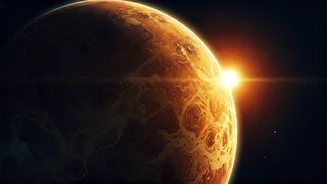
Venus is often called Earth's twin due to its similar size and mass, but the similarities end there. It’s a hellish world with a crushing carbon dioxide atmosphere, surface temperatures hot enough to melt lead, and sulphuric acid clouds. And then there's
its timekeeping. While Earth gracefully pirouettes once every 24 hours, Venus engages in an incredibly lazy spin. For decades, scientists have known that a day on Venus was longer than its year, but recent astrophysical measurements have painted a much clearer, and even stranger, picture of this planetary anomaly.
Putting Numbers to the Weirdness
Let’s break down the bizarre maths. A year on Venus—the time it takes to complete one orbit around the Sun—is about 224.7 Earth days. A 'day' on Venus, however, is more complicated. A sidereal day, which is one full rotation on its axis, was recently measured with unprecedented precision to be 243.0226 Earth days. This means a single spin of the planet takes longer than its entire journey around the Sun. Because Venus also spins in the opposite direction to most other planets (a phenomenon called retrograde rotation), its solar day (the time from one sunrise to the next) is different again, lasting about 117 Earth days. No matter how you slice it, the Venusian calendar is profoundly weird.
How Scientists Took Venus's Pulse
The new, ultra-precise data comes from a groundbreaking study led by researchers at UCLA. Over a 15-year period, from 2006 to 2020, they used a powerful technique involving radio telescopes. They bounced radar signals off the surface of Venus from NASA's Goldstone Antenna in California and studied the echoes received at the Green Bank Observatory in West Virginia. By analysing the tiny shifts in how these signals returned, they could track specific surface features and measure the planet's rotation speed with an accuracy of milliseconds. It was like taking the planet's pulse from over 40 million kilometres away, allowing them to pinpoint the length of its day better than ever before.
A Wobbly World with a Heart
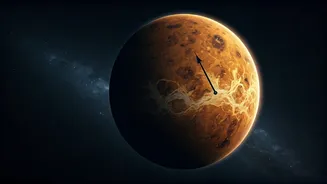
This research delivered more than just a precise day length. The team found that Venus's spin isn't perfectly steady; it wobbles slightly, a motion called precession, much like a spinning top. By measuring this wobble, they precisely determined the tilt of Venus's axis to be 2.6392 degrees (Earth's is about 23 degrees). This data, combined with the planet’s spin rate, allowed the scientists to peer inside. They calculated the size of Venus’s core for the first time, estimating it to be about 3,500 kilometres in radius—quite similar to Earth's. However, they still don't know if the core is liquid or solid, a key question for future missions.
Why This Bizarre Planet Matters
Understanding Venus is more than just a cosmic curiosity. Its slow, backward rotation is a major puzzle. Is it the result of a massive ancient collision that sent it spinning the wrong way? Or is it due to the immense drag from its incredibly thick atmosphere, which acts like a brake on the planet's surface? The thick atmosphere itself is a cautionary tale—a runaway greenhouse effect that serves as a stark warning for our own planet's climate. By precisely measuring Venus's fundamental properties—its spin, its wobble, and its internal structure—we gather crucial data points to test our theories of how planets form, evolve, and what makes a world habitable… or hostile.