





A Cosmic Seismograph
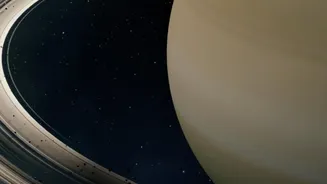
Imagine using a record player to understand what’s happening in the room next door. That’s essentially what scientists are doing with Saturn, in a practice known as ring seismology, or 'kronoseismology'. The planet’s interior is not static; it gently
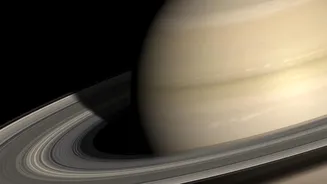
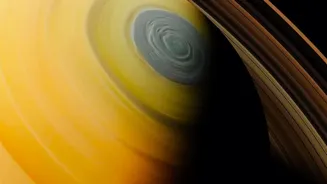
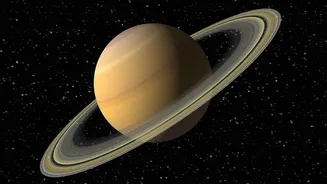
oscillates and vibrates, much like a subtle, continuous earthquake. These vibrations cause tiny shifts in Saturn's gravitational field. For the trillions of icy particles in the rings, this is a big deal. The planet's gravitational pulsing makes the ring particles wiggle, creating subtle but detectable spiral patterns and ripples. By studying these waves, captured in breathtaking detail by NASA’s Cassini spacecraft, astronomers can probe the planet's deep structure without ever sending a probe through its crushing atmosphere. The rings, in effect, act as a massive, hyper-sensitive seismograph, recording the rumbles from the planet's hidden heart.
A Surprisingly 'Fuzzy' Core
For decades, the standard model for a gas giant like Saturn included a small, compact core of rock and ice. The data from the rings, however, tells a completely different story. Instead of a solid ball, Saturn appears to have a huge, 'fuzzy' core. Scientists describe it as a diffuse, soupy mixture of ice, rock, and metallic fluids—more like a sludge than a solid sphere. This core is enormous, extending across an estimated 60% of the planet's diameter and containing the mass of about 17 Earths. The transition from this slushy core to the planet's gassy outer envelope is gradual, with no clear boundary. This discovery was a profound surprise, completely upending previous assumptions about the internal structure of the solar system’s second-largest planet.
Rewriting Planetary History
This discovery of a fuzzy core sends ripples through our understanding of how giant planets are born. The leading theory, known as core accretion, suggests that a solid core of rock and ice forms first, and its gravity then rapidly pulls in the vast amounts of hydrogen and helium gas that make up the bulk of the planet. But a diffuse, slushy core doesn't quite fit this neat picture. It suggests a messier, more complex formation process where heavier elements didn't fully separate and sink to the center but remained mixed with the lighter gases. Understanding this structure is crucial because it provides a direct window into the conditions of the early solar system, some 4.5 billion years ago. By decoding the story told by Saturn's core, scientists hope to refine their models for how all planets, including those beyond our own solar system, evolve.
A Question of Age
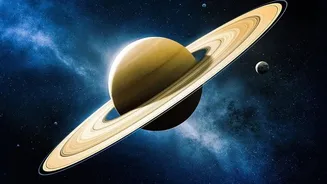
The rings don't just hold clues about the planet's deep past; their own origin is a major piece of the historical puzzle. For years, data from Cassini suggested the rings were remarkably young—perhaps only 100 to 400 million years old. The reasoning was that the rings are made of 99% pure water ice and appear incredibly bright. Over billions of years, they should have been darkened by a constant rain of dusty micrometeoroids, like a clean carpet gathering dust over time. This led to the theory that the rings were formed relatively recently, perhaps from an icy moon that was shattered by a collision when dinosaurs roamed the Earth. However, a newer study published in late 2024 challenges this idea, proposing the rings could be as old as Saturn itself. Using computer models, researchers demonstrated that micrometeoroid impacts might not 'dirty' the rings as expected. Instead, the intense energy of these tiny collisions could vaporize the particles, with the resulting charged gas being swept away by Saturn's magnetic field. If true, this self-cleaning mechanism would mean the rings could be 4.5 billion years old and still look pristine, preserving a direct link to the dawn of the solar system. This active scientific debate highlights how much we still have to learn.