
A New Powerhouse in the Cosmos
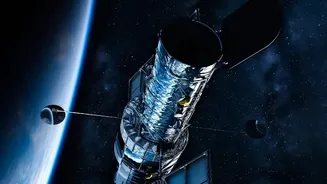
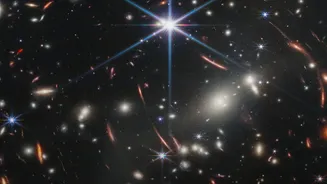
Since its launch, the James Webb Space Telescope has been hailed as a revolutionary tool for astronomy, and for good reason. Its immense mirror and advanced instruments are designed to capture faint infrared light from the dawn of time. But one of its most
exciting missions is much closer to home, galactically speaking: studying exoplanets, or planets orbiting other stars. Specifically, its ability to analyze the thin sliver of starlight that passes through an exoplanet's atmosphere is what has scientists on the edge of their seats. This technique, called transmission spectroscopy, allows JWST to read the chemical barcode of an alien sky, detecting molecules like water, methane, and carbon dioxide. For the first time, we have an instrument powerful enough to probe the skies of worlds the size of our own.
The Challenge of Rocky Planets
While JWST has already provided stunning insights into the atmospheres of large gas giants, the ultimate prize is the study of small, rocky planets. These are worlds that, like Earth, could potentially have a solid surface and, if conditions are right, liquid water. However, their atmospheres are significantly thinner and harder to detect. For years, observations have been tantalizing but inconclusive. The first wave of JWST data is changing that, providing our first concrete evidence of what these worlds are — and are not — made of. The findings are complex, sometimes contradictory, but always groundbreaking.
A Groundbreaking Find at 55 Cancri e
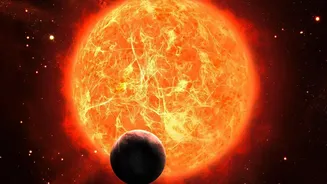
One of the most significant early breakthroughs came from the super-Earth 55 Cancri e, a rocky world so close to its star that its surface is likely a molten ocean of magma. It was considered a long shot for retaining any significant atmosphere. Yet, in May 2024, researchers announced that JWST had found the best evidence to date for a substantial atmosphere around a rocky exoplanet. The telescope measured the planet's thermal emission, finding it was cooler than a bare rock world should be, suggesting heat was being distributed by a thick atmosphere. The data hints this atmosphere could be rich in carbon dioxide or carbon monoxide, possibly bubbling out of the magma ocean below. More recent data from July 2026 suggests the atmosphere may even be hydrogen-rich and dynamic, shaped by volcanic outgassing. This discovery proved that even under extreme conditions, a rocky planet can hold onto a significant gaseous envelope.
The Enigmatic TRAPPIST-1 System
The TRAPPIST-1 system, with its seven Earth-sized planets, has been a top target for JWST. Three of its planets orbit in the 'habitable zone,' where liquid water could exist. However, the initial findings have been a story of absence. Observations of the innermost planets, TRAPPIST-1b and 1c, show extreme temperature differences between their day and night sides, suggesting they have little to no atmosphere to circulate heat. Studies of TRAPPIST-1d also found no evidence of a thick, life-supporting atmosphere. Even for TRAPPIST-1e, a prime candidate in the habitable zone, results remain ambiguous. While a thick, hydrogen-rich atmosphere has been ruled out, scientists are still trying to determine if it has a thinner, heavier atmosphere (like Earth's) or is just a bare rock.
Hope in the Habitable Zone: LHS 1140 b
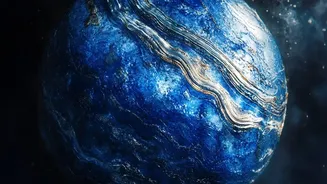
More promising signs have recently emerged from another super-Earth, LHS 1140 b, located 48 light-years away in its star's habitable zone. This planet is larger and more massive than Earth, and early JWST observations have ruled out a hydrogen-dominated atmosphere. Instead, analyses from mid-2024 suggest it could have a high mean molecular weight atmosphere, possibly containing nitrogen, water vapor, and carbon dioxide. Some scientists have even detected hints of helium escaping the planet, which is considered strong evidence that an atmosphere is present. While some JWST data has not yet confirmed the helium detection, the possibility remains a landmark in the search for habitable worlds. Finding any atmosphere on a rocky planet in the habitable zone is a crucial first step toward identifying worlds that might support life.