


Why Five Minutes Truly Counts
The 'all-or-nothing' approach to fitness often leads to nothing. The good news is that science supports the 'something is better than nothing' mantra. Studies show that short, consistent bursts of exercise offer significant health benefits. Research indicates
that even brief periods of vigorous activity can improve cardiovascular health, boost metabolism, enhance mood, and increase mental clarity. The key is consistency and intensity. Making exercise a daily habit, even for just five minutes, is more sustainable and often more effective in the long run than sporadic, longer gym sessions. These 'exercise snacks' can be accumulated throughout the day to meet weekly activity goals and are particularly effective for building a lasting fitness habit.
The 5-Minute Full-Body Circuit
The goal is to work major muscle groups efficiently. This circuit is designed to provide a balanced, full-body workout using only your body weight. Perform each of the following five exercises for 45 seconds, with 15 seconds to transition to the next move. This creates a continuous five-minute block of effort that challenges your muscles and elevates your heart rate.
1. Jumping Jacks (The Warm-Up)
Start your circuit by getting your blood pumping. Jumping jacks are a classic cardiovascular exercise that warms up your entire body, including your shoulders, hips, and core. Stand with your feet together and your arms at your sides. In one motion, jump your feet out to the sides and raise your arms above your head. Immediately reverse the motion to return to the starting position. Maintain a brisk, steady pace.
2. Bodyweight Squats (Lower Body Strength)
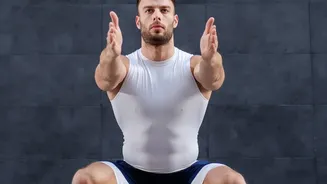
Squats are a fundamental movement that targets the largest muscles in your body: your glutes and quadriceps. Stand with your feet shoulder-width apart, chest up, and core engaged. Lower your hips back and down as if sitting in a chair, keeping your knees aligned over your toes. Aim to get your thighs parallel to the floor before pushing through your heels to return to the starting position. For a modification, practice by sitting down onto and standing up from a sturdy chair.
3. Push-Ups (Upper Body and Core)
Push-ups are a powerful exercise for your chest, shoulders, triceps, and core. Start in a plank position with your hands slightly wider than your shoulders. Keeping your body in a straight line from head to heels, lower your chest toward the floor. Push back up to the starting position. If a standard push-up is too challenging, you can modify it by dropping to your knees or performing them against a wall.
4. Plank (Core Stability)
The plank is an isometric exercise that builds incredible core strength and stability, which is crucial for good posture and preventing back pain. Position yourself on your forearms and toes, keeping your body in a straight, rigid line. Engage your abs and glutes, and be careful not to let your hips sag or rise too high. Hold this position, focusing on your breathing.
5. Glute Bridges (Posterior Chain)
Finish your circuit by focusing on the often-neglected posterior chain. Lie on your back with your knees bent, feet flat on the floor, and arms at your sides. Squeeze your glutes and lift your hips off the floor until your body forms a straight line from your shoulders to your knees. Hold for a moment at the top before lowering your hips back down in a controlled manner.
Making the Habit Stick
The biggest challenge isn't the five minutes of exercise; it's doing it every day. To build a lasting habit, try 'habit stacking'. Link your new five-minute workout to an existing daily ritual, like right before your morning shower or immediately after you brush your teeth. Laying out your workout clothes the night before can also serve as a powerful visual cue. Remember to start small and focus on consistency first—the intensity can come later.