



The Path They Travel
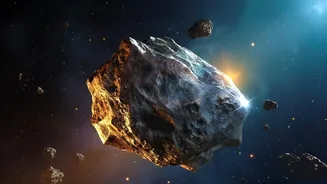
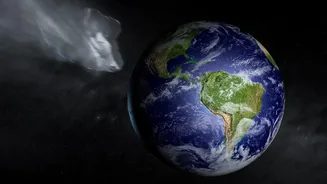
One of the most significant clues to an object's origin is its orbit. Natural objects like asteroids and meteoroids follow paths governed by the gravity of the Sun and other planets. Their orbits are often elliptical and can be tilted at various angles.
In contrast, man-made space junk, such as old rocket stages and dead satellites, typically circles the Earth in more predictable patterns. Most were placed in specific orbits for operational reasons—like west-to-east paths for communication satellites—and they tend to stick to those highways unless their orbit decays. By tracking an object's trajectory with radar or optical telescopes, scientists can quickly determine if its path is typical of something launched from Earth or something that has been travelling through the solar system for millennia.
Clues in the Light
Another powerful tool is spectroscopy, which involves analysing the light that an object reflects. Every material reflects light in a unique way, creating a sort of chemical fingerprint. Natural space rocks are primarily made of silicate minerals or iron-nickel. Space junk, on the other hand, is made of materials like stainless steel, aluminium, and the special paints and polymers used on spacecraft. By capturing the spectrum of light from an object, scientists can identify these tell-tale signs. For example, an object showing the spectral signature of steel and specific man-made polymers is almost certainly a piece of space junk, not an asteroid. This technique is crucial for confirming an object's identity when its orbit alone isn't conclusive.
Shine and Spin
How an object's brightness changes over time, known as its light curve, also provides valuable information. Asteroids are often irregularly shaped and tumble as they move, causing their reflected light to vary in a pattern that reveals their rotation and rough shape. Man-made objects, however, often have distinct, non-natural shapes like cylinders or flat panels. Solar panels can cause sharp, intense flashes of light, or glints, that are very different from the more gradual changes of a tumbling rock. While both natural and artificial objects can have a high 'albedo' (reflectivity), the patterns of brightness are often a giveaway. Polished metals on satellites can appear brighter than a similarly sized asteroid. Scientists analyse these light curves to build a model of the object's shape and spin, helping to distinguish a discarded rocket body from a carbon-rich asteroid.
Speed and Density
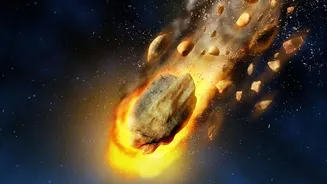
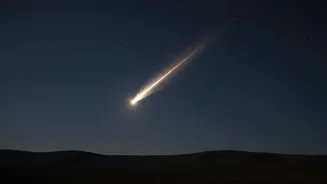
The speed and density of an object offer further clues. Meteoroids entering Earth's atmosphere from deep space are accelerated by Earth's gravity and hit the upper atmosphere at incredibly high speeds, causing them to burn up quickly in a bright, fleeting streak. Re-entering space debris is already in Earth's orbit and moves relatively slower, often resulting in a slower, longer-lasting burn across the sky. Furthermore, space junk is often less dense. Some defunct rocket bodies are so lightweight for their size that the gentle pressure from sunlight alone is enough to alter their course—a phenomenon not seen with dense, solid asteroids. By combining data from radar, which can help determine velocity and distance, with optical observations, scientists can build a complete profile of the object’s physical characteristics.