

A New Era of Lunar Ambition
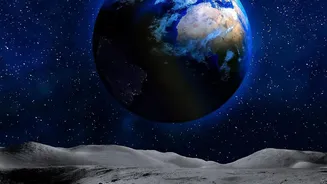
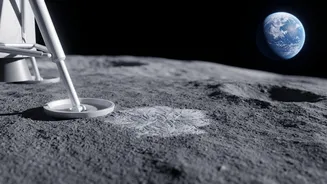
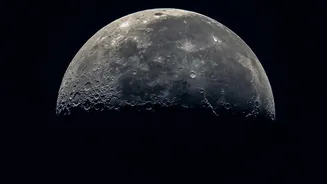
The Moon is once again the focus of global ambition. NASA's Artemis program aims to establish a long-term human presence there, while nations like China and India are pursuing their own advanced robotic and crewed missions. This renewed push to our celestial
neighbour is not just about planting flags; it's about science, resource utilisation, and establishing a foothold for deeper space exploration. But as we prepare to return, we face a complex challenge that goes beyond engineering and rocketry: the risk of biological contamination. Every human, and every piece of equipment we send, is covered in a universe of microorganisms.
The Hardy Stowaways: Earth's Extremophiles
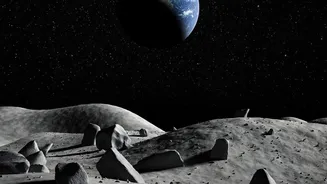
The lunar surface is incredibly hostile. It's a vacuum with no air, blasted by intense ultraviolet (UV) radiation, and subject to wild temperature swings from over 120°C in sunlight to below -170°C in darkness. For most life, this is an instantly lethal environment. But Earth is home to a class of organisms known as extremophiles, which thrive in conditions that would kill most other life forms. Recent research, however, has been surprised to find that even common microbes, not typically considered extremophiles, show remarkable resilience. One such organism is the fungus Aspergillus niger, a common black mould found in our homes, which has been found surviving on the exterior of the International Space Station.
What the NASA Study Discovered
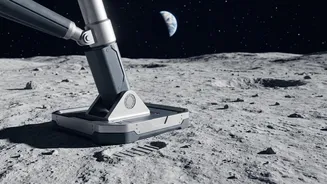
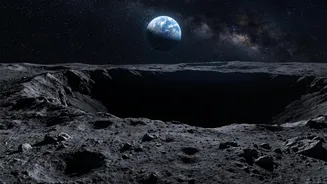
A recent study led by NASA scientists, published in Science Advances, has put this resilience to the test. Using computer models based on data from NASA's Lunar Reconnaissance Orbiter, researchers simulated conditions near the Moon's south pole, a key target for future Artemis landings. They found that the unique geography of the poles, with permanently shadowed craters that never see sunlight, creates ultra-cold, shielded micro-niches. The study modeled the survival chances of five common human-associated microbes and found that all could potentially survive, at least temporarily, in these shaded regions. While they wouldn't grow or reproduce, they could enter a dormant state, with the fungus Aspergillus niger being particularly tough, even surviving brief exposure to sunlight.
The Problem with Forward Contamination
Why does this matter? The issue is called 'forward contamination'—the transfer of life from Earth to another celestial body. Scientists want to study the Moon to understand its history and the history of our solar system. The permanently shadowed craters at the poles are of special interest because they may hold water ice and preserve a pristine chemical record going back billions of years, including clues to how life may have started. If we introduce Earth microbes, we could contaminate these sites. Future discoveries of organic molecules or even signs of life could be compromised, as scientists would struggle to determine if what they've found is genuinely lunar or just a hitchhiker from Earth.
Rethinking Planetary Protection
International agreements, guided by the Committee on Space Research (COSPAR), set out planetary protection policies to avoid this kind of contamination. Historically, the Moon was considered low-risk because its harsh environment was thought to be sterilizing. However, discoveries of water ice and now the potential for microbial survival are forcing a reassessment. While the COSPAR policy is not legally binding, it is the international standard that responsible space-faring nations follow to comply with the 1967 Outer Space Treaty. This new NASA research highlights the need for stricter protocols, especially for missions heading to the scientifically valuable polar regions. This could involve more rigorous decontamination of equipment and careful tracking of every material brought to the lunar surface.