





The Sun's Perpetual Gust
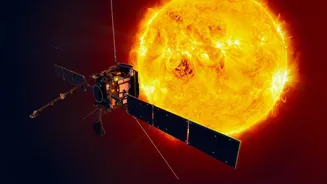
Imagine the Sun not just as a source of light and heat, but as a star constantly exhaling a stream of charged particles. This stream is the solar wind, a plasma of protons and electrons that travels through the solar system at speeds of 400 to 800 kilometres
per second. It carries with it a part of the Sun’s own magnetic field. While mostly invisible to us, this solar wind is a fundamental force in our cosmic neighbourhood, interacting with every planet, including our own. It's the reason comet tails always point away from the Sun and the primary driver of what we call space weather.
Earth's Invisible Shield
Thankfully, Earth isn't defenceless. Our planet's molten iron core generates a powerful magnetic field that extends far out into space, creating a protective bubble called the magnetosphere. This shield deflects the majority of the solar wind, preventing it from stripping away our atmosphere. The pressure from the solar wind continuously squashes the magnetosphere on the side facing the Sun and stretches it into a long tail on the night side, like a windsock in a gale. This boundary, known as the magnetopause, is in constant motion, buffeted by the ever-changing solar wind.
Enter the Magnetometer
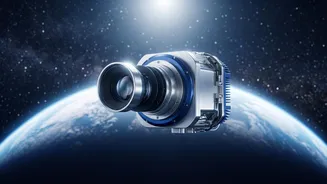
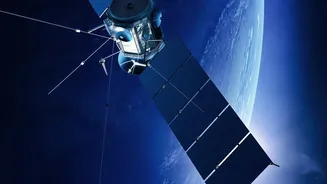
So if this interaction is invisible, how do scientists track it? They use magnetometers, which are essentially highly sensitive compasses. These instruments are designed to measure the strength and direction of magnetic fields. They have been placed on the ground in a global network and on satellites, such as those in the GOES system, which have been monitoring the space environment since 1975. These devices continuously record the magnetic field's state, providing a baseline reading of its normal behaviour. Even modern smartphones contain simple magnetometers for their navigation systems, which some citizen science projects use to collect data.
Reading the Wiggles
The key to tracking solar wind impacts is looking for deviations from that baseline. When a powerful gust of solar wind or a massive eruption from the sun called a Coronal Mass Ejection (CME) hits the magnetosphere, it compresses and disturbs Earth's magnetic field. This sudden change causes a 'wiggle' or variation in the data collected by magnetometers. A significant, sustained southward direction in the solar wind's magnetic field is particularly effective at transferring energy into our magnetosphere, triggering a geomagnetic storm. By monitoring these real-time data streams, scientists can detect the onset of these storms, sometimes with a 30-60 minute warning from satellites positioned between the Earth and Sun.
Why the Data Matters
Tracking these deflections isn't just an academic exercise. Geomagnetic storms can have significant real-world consequences. The energy they inject into our system can induce currents that disrupt power grids, potentially causing blackouts. They can also interfere with satellite operations, affecting everything from GPS navigation—including systems like India's NavIC—to telecommunications. Astronauts in space are also at risk from the increased radiation. On the beautiful side, these same particle interactions are what create the stunning auroras—the Northern and Southern Lights—as they collide with gases in our upper atmosphere. By understanding magnetometer data, we can better forecast space weather and protect the technology our modern world depends on.