



Beyond Just Finding Water
For years, astronomers have detected hints of water on exoplanets, planets outside our solar system. However, these detections were often limited, obscured by thick clouds or haze that older telescopes couldn't penetrate. The conversation is now changing
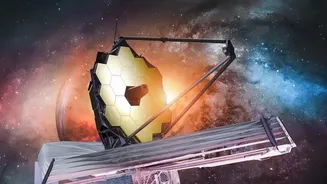
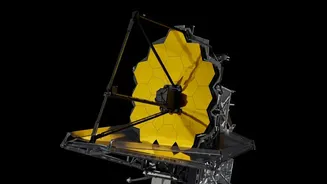
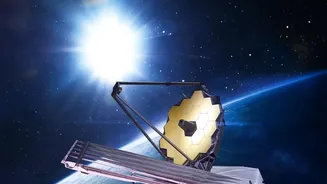
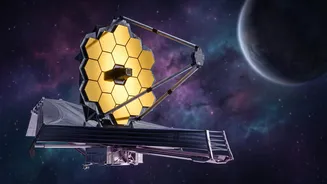
from "Is there water?" to "What is that water like?" This is where the James Webb Space Telescope excels. It’s providing not just confirmation of water vapour, but a detailed profile of the conditions in these alien atmospheres. Scientists are now able to gather data on temperature, atmospheric composition, and even cloud structure, painting a far more complete picture of these worlds than ever before.
Webb’s Infrared Advantage
The key to these new insights lies in Webb’s powerful infrared sensors, specifically its Mid-Infrared Instrument (MIRI). While visible light is often blocked by thick atmospheric haze, infrared light—which we feel as heat—can pass through. Webb uses a technique called spectroscopy. As an exoplanet passes in front of its host star, the telescope captures the starlight filtering through the planet's atmosphere. Different molecules absorb light at specific infrared wavelengths, leaving a unique chemical fingerprint. By analyzing this fingerprint, scientists can identify the molecules present, such as water vapour, methane, and sulfur dioxide. This capability allows Webb to peer through atmospheric layers that were previously impenetrable, unlocking the secrets they hold.
A Portrait of a Distant Atmosphere
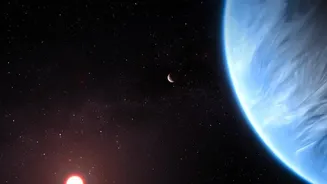
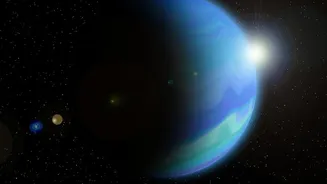
Take GJ 1214 b, a type of planet known as a “mini-Neptune” about 48 light-years away. For nearly a decade, its atmosphere was a complete mystery due to a thick blanket of clouds. Using MIRI, scientists were able to create a heat map of the planet as it orbited its star. The data revealed a steamy atmosphere, likely rich in water vapour and possibly methane. The significant temperature difference between the planet's hot day side and its cooler night side told scientists that the atmosphere must be composed of heavier molecules, like water, rather than lighter hydrogen. This suggests the planet may have formed farther from its star, where water ice is abundant, and migrated inward over time, becoming the scorching, steamy world it is today. These aren't just guesses; they are detailed inferences drawn from the specific data only Webb can provide.
The Quest for Habitable Worlds
While steamy mini-Neptunes like GJ 1214 b are too hot for liquid water and life as we know it, the techniques used to study them are revolutionary for the search for habitable planets. Recently, Webb has detected water vapour in the inner, rocky-planet-forming zone of a young star system called PDS 70. This discovery is exciting because it shows that the essential ingredients for life are available in the very regions where Earth-like planets might be assembling. By proving its ability to analyze the atmospheric composition of various planet types, Webb is building a toolkit that can be applied to smaller, rocky worlds that might orbit within their star's habitable zone—the region where liquid water could exist on a planet's surface. Every steamy mini-Neptune and fluffy gas giant studied brings us one step closer to being able to characterize a truly Earth-like world.