


Meet the Super-Earths
Before we dive into the latest findings, what exactly is a super-Earth? The term describes a class of exoplanet—a planet outside our solar system—that is larger than Earth but smaller than Neptune. They are incredibly common in our galaxy, yet our own
solar system curiously lacks one. These worlds are a top target for astronomers. Their size means they are massive enough to hold onto an atmosphere, but not so large that they become gas giants. This raises tantalizing questions: Could they be rocky like Earth, or are they something else entirely? A recent focus of the JWST has been a super-Earth named 55 Cancri e, located 41 light-years away in the constellation Cancer. With a diameter about twice that of Earth, it orbits its star so closely that a year lasts only 18 hours, and its surface is thought to be a bubbling ocean of magma.
Webb's Chemical Fingerprinting
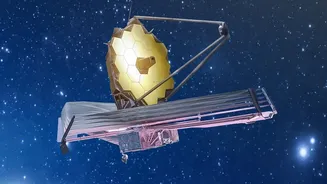
The JWST can’t take a direct picture of 55 Cancri e, but it can do something arguably more powerful. It uses a technique called infrared spectroscopy. When the planet passes behind its star, scientists measure the system’s total light. By subtracting the light of just the star, they can isolate the light coming from the planet's day-side. This light contains a chemical fingerprint. Different molecules in an atmosphere absorb and emit specific wavelengths of infrared light. By analyzing this spectrum, astronomers can identify the gases present. This is exactly what a team of researchers did using Webb's Near-Infrared Camera (NIRCam) and Mid-Infrared Instrument (MIRI), which are sensitive enough to parse the thin, tenuous atmospheres of rocky worlds—a feat that was previously out of reach.
A Surprising Discovery on a Lava World
The observations of 55 Cancri e yielded a huge surprise. If the planet were a bare rock, its dayside temperature should be around 2,200 degrees Celsius. Instead, Webb’s instruments measured a significantly cooler temperature of about 1,540 degrees Celsius. This strongly suggests that an atmosphere is present, circulating heat from the blistering dayside to the perpetual nightside of the tidally-locked planet. Analysis of the light spectrum indicates this atmosphere is rich in either carbon monoxide or carbon dioxide. This finding is the best evidence to date for an atmosphere around a rocky exoplanet outside our solar system. More recent analysis from July 2026 further suggests the presence of surprisingly large amounts of hydrogen, which defies older models that predicted only carbon-based gases.
An Atmosphere From a Magma Ocean
So, where did this atmosphere come from? Given the planet's extreme heat and proximity to its star, any original, or 'primary,' atmosphere would have been stripped away long ago. Scientists believe they are seeing a 'secondary' atmosphere, one that is continuously being replenished. The theory is that the gases are bubbling up from the vast magma ocean that covers the planet. Just as magma on Earth contains dissolved gases, the molten rock on 55 Cancri e is likely outgassing a steady supply of molecules to maintain its atmosphere. Some data even points to variations between observations, suggesting dynamic processes like volcanic outgassing could be creating temporary, shifting clouds.