





Just How Slow Is It?
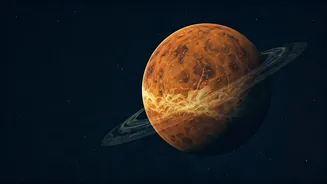
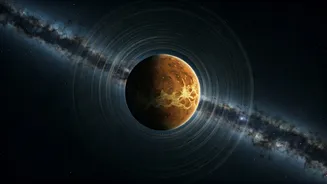
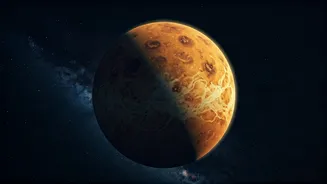
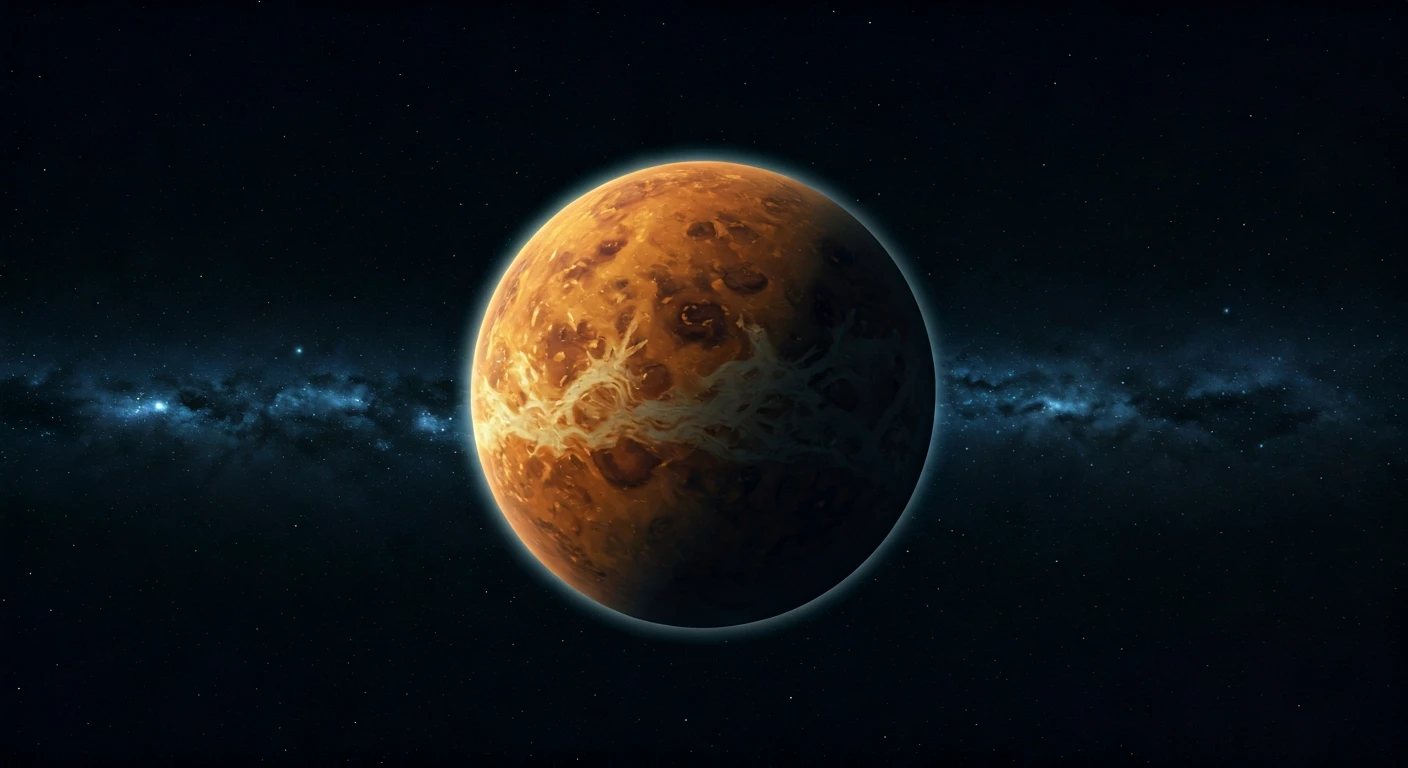
To say Venus has a leisurely spin is an understatement. It takes a staggering 243 Earth days for Venus to complete a single rotation on its axis. For comparison, Earth takes just under 24 hours, and the fastest-spinning planet, Jupiter, does it in less
than 10 hours. Venus's rotation is so slow that a person could walk at a brisk pace at the equator to stay in perpetual twilight. This glacial pace makes Venus the undisputed champion of slow rotation in our solar system, far slower than the next in line, Mercury, which spins once every 59 Earth days.
A Day Longer Than A Year
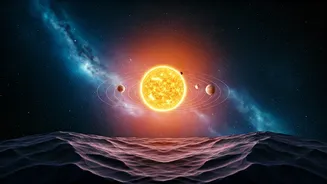
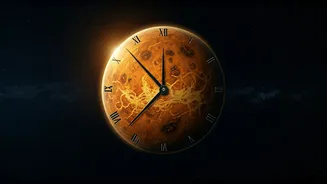
Here's where it gets truly mind-bending. While Venus takes 243 Earth days to spin once (a sidereal day), it takes only about 225 Earth days to complete one full orbit around the Sun (a Venusian year). This means a day on Venus is longer than its year. However, because the planet is also moving around the Sun, the time from one sunrise to the next (a solar day) is different. On Venus, a solar day lasts about 117 Earth days, meaning you'd only see the Sun rise and set about twice during a whole Venusian year.
Spinning The Wrong Way
Adding to the strangeness, Venus spins backwards. Unlike Earth and most other planets in the solar system, which rotate counter-clockwise on their axis, Venus has a retrograde (clockwise) rotation. If you could stand on its surface, you would see the Sun rise in the west and set in the east. Scientists aren't entirely sure why. The two leading theories both involve immense forces. One idea is that Venus was struck by a massive object early in its history, which was powerful enough to reverse its original spin. Another theory suggests that the planet wasn't hit, but simply flipped upside down on its axis. In this scenario, it would still be spinning in its original direction, but from our perspective, it would appear to be rotating backwards.
The Atmosphere's Heavy Hand
A more recent and compelling theory points to Venus's own atmosphere as the culprit. The planet is shrouded in an incredibly dense atmosphere, about 93 times the pressure of Earth's at sea level, composed almost entirely of carbon dioxide. This heavy blanket of gas is thought to have created a powerful braking effect over billions of years. The Sun's gravity pulls on this thick atmosphere, creating atmospheric tides much like the Sun and Moon create ocean tides on Earth. This constant gravitational tug-of-war on the atmosphere could have slowed the planet's rotation to a crawl and may have even been powerful enough to reverse it.
A World Shaped by a Slow Spin
This slow rotation has profound consequences. On Earth, our relatively fast spin helps generate a protective magnetic field. Venus's slow spin means it lacks a significant internal dynamo, leaving it with a very weak magnetic field that offers little protection from the solar wind. You might also expect extreme temperature differences between the day and night sides, but Venus's thick atmosphere is brutally efficient at distributing heat. Winds in the lower atmosphere circulate heat so effectively that the night side is nearly as hot as the day side, with surface temperatures constantly hovering around a lead-melting 467 degrees Celsius. This creates a runaway greenhouse effect, making Venus the hottest planet in the solar system, even hotter than Mercury, which is closer to the Sun.