


What Exactly Is a Solar Storm?
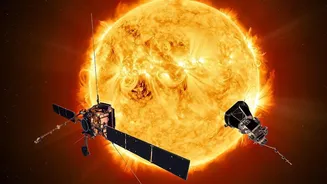
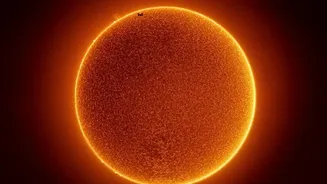
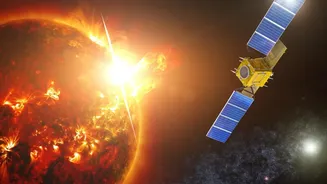
A solar storm is a powerful disturbance on the sun that can send streams of energy and particles hurtling into space. These events are driven by the sun’s tangled magnetic fields. When these field lines twist and snap, they can release enormous bursts
of energy in two main forms. First are solar flares, which are intense flashes of radiation that travel at the speed of light, reaching Earth in about eight minutes. The second, and often more impactful, are Coronal Mass Ejections (CMEs). These are massive clouds of magnetised plasma and solar particles that are blasted from the sun's outer atmosphere, the corona. While flares are a flash of light, CMEs are like a cannonball of solar material, taking anywhere from 18 hours to several days to reach our planet.
The Journey to Earth
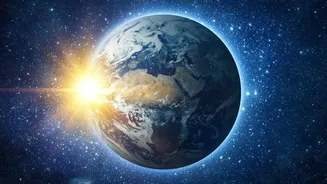
When a CME is aimed at Earth, it travels across the solar system and slams into our planet's protective magnetic shield, the magnetosphere. This collision triggers a major disturbance known as a geomagnetic storm. While our magnetosphere deflects most of the harmful particles, a strong storm can rattle this shield, allowing energy and particles to pour into our upper atmosphere. This interaction is what creates the beautiful auroras at the poles, but it’s also the source of significant technological disruption. The particles energise the atmosphere, and the fluctuating magnetic fields can induce powerful electrical currents in conductors on the ground and in orbit.
Satellites in the Firing Line
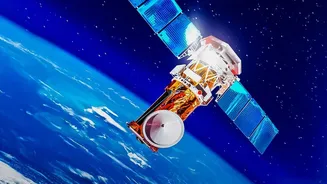
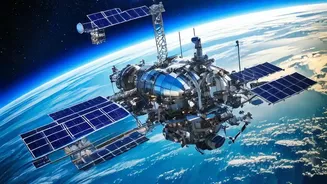
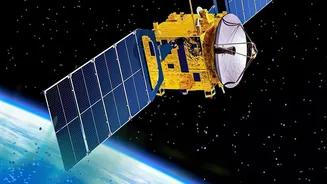
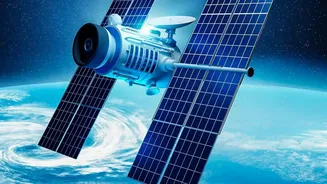
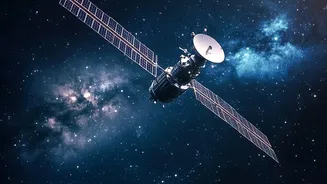
Satellites, particularly those in Low Earth Orbit (LEO), are extremely vulnerable. First, the energy from a solar storm heats and expands Earth's upper atmosphere. This increases atmospheric drag, acting like a brake on satellites. This can cause them to lose altitude and, in severe cases, fall out of orbit and burn up, as happened to dozens of Starlink satellites in February 2022. Second, high-energy particles can bombard a satellite's electronics, causing short circuits, corrupted data, and even permanent failure. This is known as single-event upset. Finally, the storm can interfere with the radio signals used for communication and navigation, leading to inaccurate GPS readings or a total loss of connection.
Disruption on the Ground
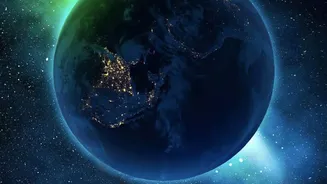
The effects aren't limited to space. Geomagnetic storms can induce powerful, uncontrolled currents in long terrestrial conductors. These are called geomagnetically induced currents (GICs). Power grids are especially susceptible. GICs can flow into high-voltage transformers, causing them to overheat and fail, potentially leading to widespread blackouts. A 1989 storm did just that, plunging Quebec, Canada, into darkness for nine hours. Long-distance pipelines and undersea communication cables are also at risk. The repeaters that boost the signal in fibre-optic cables are vulnerable to GICs, which could disrupt the global internet.
A Modern Carrington Event?
The benchmark for a worst-case scenario is the Carrington Event of 1859. This was the most powerful geomagnetic storm in recorded history, caused by a massive CME. Telegraph systems across the world failed, operators received electric shocks, and papers were set on fire by sparks from the equipment. The aurora was so bright that people could read newspapers by its light, and it was visible as far south as Cuba and Hawaii. If a storm of that magnitude were to occur today, the impact on our electrically dependent society would be catastrophic, potentially causing trillions of dollars in damage and widespread blackouts that could last for weeks or months.
Forecasting and Mitigation
Fortunately, we aren't completely defenseless. Agencies like NOAA's Space Weather Prediction Center constantly monitor the sun, providing forecasts and warnings that give satellite operators and grid managers time to prepare. Mitigation strategies include putting satellites into a protective "safe mode," rerouting air traffic away from the poles where radiation is highest, and adjusting operations on the power grid to better handle induced currents. Engineers are also working on building more resilient hardware, known as "hardening," to better withstand the harsh radiation environment of space. While the threat is real, a combination of better forecasting, smarter operations, and more robust technology helps to shield our connected world from the sun's occasional fury.