



The Sun’s Powerful Magnetic Personality
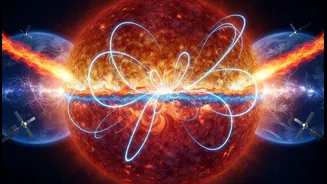
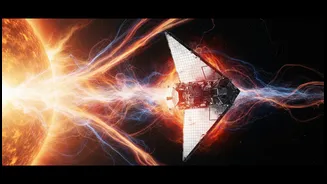
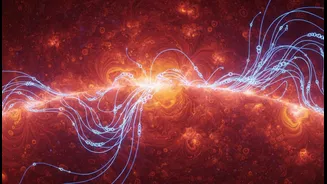
The Sun’s magnetic field is the driving force behind almost everything we call “space weather.” It dictates the famous 11-year solar cycle, creates sunspots larger than Earth, and unleashes colossal eruptions of energy known as solar flares and coronal
mass ejections (CMEs). When these eruptions are aimed at Earth, they can disrupt satellite communications, endanger astronauts, and even threaten power grids on the ground. Understanding how this magnetic field is generated and organised is therefore not just an academic question; it is crucial for protecting our increasingly technology-dependent world. For decades, scientists have theorised that a key component of this process, known as the solar dynamo, lies deep within the Sun, in a region that is impossible to observe directly.
Meet the Tachocline: A Mysterious Shear Layer
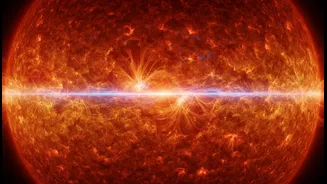
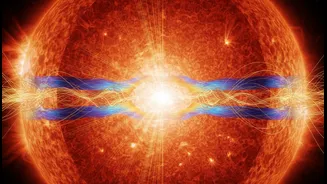
Deep beneath the Sun's visible surface lies a mysterious boundary layer called the tachocline. It sits about 200,000 kilometres down, separating two distinct zones of the solar interior. Below it is the radiative zone, which rotates like a solid, rigid ball. Above it is the convection zone, a turbulent region of boiling plasma where the Sun's equator spins faster than its poles. The tachocline is the incredibly thin shear layer where these two different rotation speeds meet. Think of it as a cosmic blender, where the velocity of solar plasma changes dramatically. Scientists have long believed this intense shearing action is where the Sun's magnetic field gets amplified, stretched, and organised, essentially winding it up and building its strength.
COFFIES: A Virtual Sun in a Supercomputer
Since we cannot send a probe into the Sun’s fiery interior, scientists need another way to test their theories. This is where the COFFIES project comes in. The name stands for “Consequences of Fields and Flows in the Interior and Exterior of the Sun,” and it is a NASA-funded science center that brings together experts from multiple institutions. Their primary tool is not a telescope, but state-of-the-art computer models. By creating a “virtual Sun” in a supercomputer, the COFFIES team can simulate the complex interplay of plasma flows and magnetic fields under conditions that replicate the solar interior. This allows them to explore fundamental questions, such as why the tachocline is so surprisingly thin and how it plays its role in the solar dynamo.
A Breakthrough in Understanding the Dynamo
Recent work from the COFFIES team has led to a significant breakthrough. Previous models struggled to explain the tachocline's extreme thinness. However, by refining their simulations, the researchers found a symbiotic relationship: the tachocline's intense shear is essential for driving the solar dynamo, but it is a fluctuating magnetic field within the layer that is key to keeping the tachocline itself thin. According to NASA, the tachocline is now believed to be the main amplifier of the solar magnetic field, a place where it is stored, organised, and eventually released to rise to the surface and form sunspots, which are the trigger points for space weather events. This work helps confirm the tachocline’s central role as the engine room for the Sun's magnetic activity.
Why Cracking the Code Matters for Earth
This research is more than just solving a cosmic puzzle. A better physical understanding of the solar dynamo and the tachocline's function is a critical step toward improving our ability to forecast the Sun’s activity cycles. Reliable space weather forecasting could give satellite operators, airlines, and power grid managers crucial advance warning of incoming solar storms, allowing them to take protective measures. As our world relies more heavily on GPS, global communications, and stable power, understanding the star next door becomes an essential part of our own planetary security. Projects like COFFIES are paving the way for a future where we are less at the mercy of the Sun’s magnetic moods and better prepared for whatever it sends our way.