






Claim Your Corner
The first step is choosing the right location. Most people default to whatever space is free, but a little strategy goes a long way. Look for a low-traffic corner, ideally with a blank wall you can face to minimise household distractions. A spot near
a window is excellent for natural light, which reduces eye strain and boosts mood, but position your desk perpendicular to the window, not directly in front of it, to avoid screen glare. The corner of a living room or a wider hallway can be perfect. The goal is to find a spot that can be psychologically separated from your relaxation zones, creating a clear mental shift when you sit down to work.
Choose Smart, Space-Saving Furniture
In a small flat, bulky office furniture is not an option. Think lean, multipurpose, and clever. A slimline desk that's just deep enough for your laptop and a notebook is often sufficient. For truly tight spaces, a wall-mounted fold-down desk (also known as a Murphy desk) is a game-changer; it provides a sturdy work surface when you need it and folds away to almost nothing when you don't. Another excellent option is a ladder desk, which combines a small work surface with vertical shelving, tackling both your desk and storage needs in one compact unit. The key is to find furniture that keeps the floor visually open, which makes the entire room feel larger.
Think Vertically for Storage
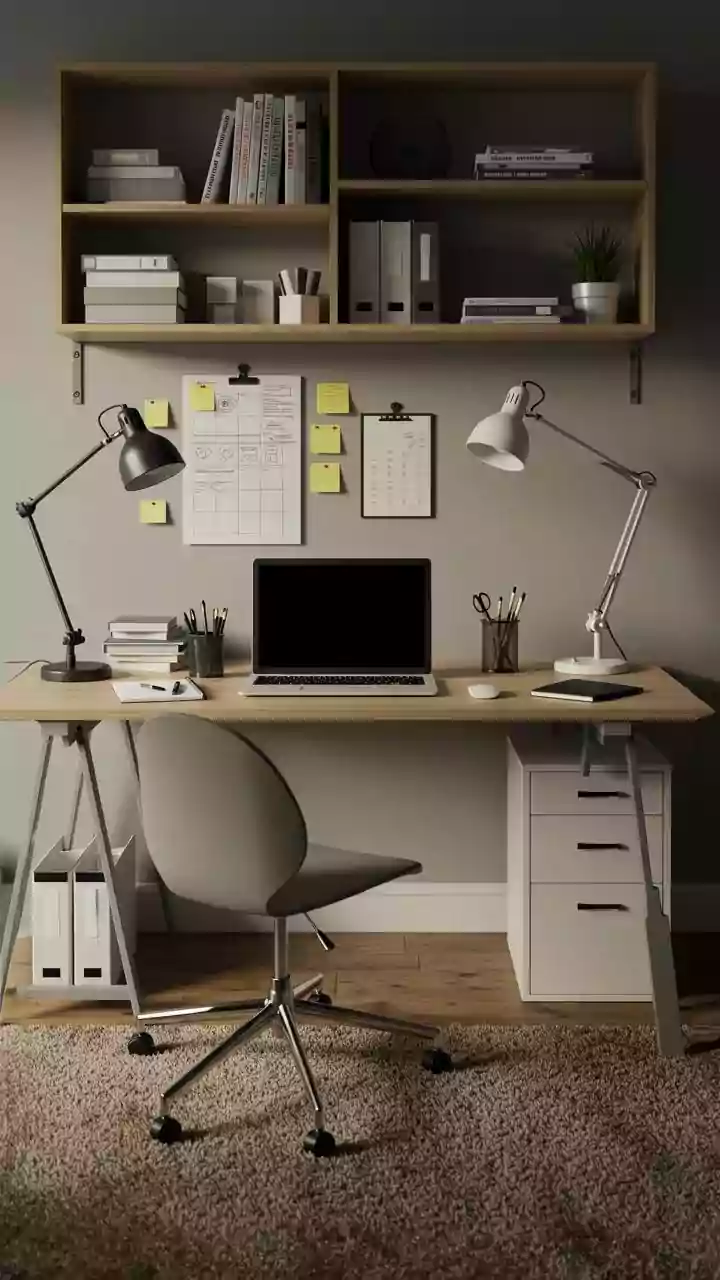
When you can't build outwards, build upwards. Your walls are your greatest untapped storage resource. Install floating shelves above your desk to hold books, files, and stationery, keeping your work surface clear. A pegboard is another versatile and stylish option, allowing you to hang everything from cables and headphones to small shelves and pots for pens. Don't neglect the space below the desk, either. A small rolling cart can be tucked underneath and moved around as needed, providing flexible storage for your essentials. These vertical solutions help you organise your supplies without eating into your precious floor space.
Light It Up Right
Good lighting is one of the most critical and often overlooked elements of a productive workspace. Relying on just the main ceiling light can create harsh shadows and eye strain. A layered approach is best. Start with the ambient light from your window or ceiling. Then, add a dedicated task light. A slim LED desk lamp is a classic choice, but if desk space is minimal, consider a clamp lamp that attaches to the edge of your desk or a wall-mounted sconce. This provides focused light directly where you need it for reading and writing, preventing your own head from casting a shadow on your work.
Define the Zone Visually
To make your work corner feel like an intentional space—and to help you 'switch off' at the end of the day—create visual boundaries. A small rug placed under your desk and chair is one of the easiest ways to define the area. You could also use a different paint colour on the wall behind your desk to create a feature 'zone'. A simple bookshelf placed perpendicular to the wall can act as a subtle room divider. These cues help signal to your brain, and to others in the household, that this small corner is a designated area for focus and work.
Master Your Cable Management
Nothing makes a small space feel more chaotic than a tangled mess of wires. A tidy workspace starts with taming your cables. Opt for wireless accessories like a keyboard and mouse where possible. For the remaining cords, use simple solutions like cable clips that stick to the side of your desk, a fabric cable sleeve to bundle them together, or a cable management box that hides the entire power strip and all its plugs. This small step makes a huge difference in reducing visual clutter and making your work corner feel calm and organised.