

Shukrayaan: India's Next Interplanetary Leap
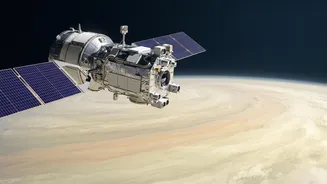
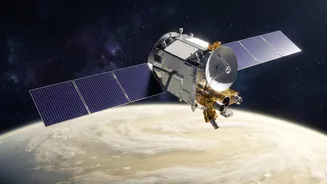
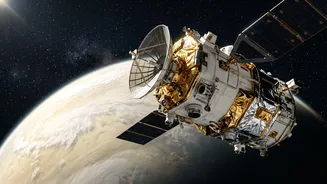
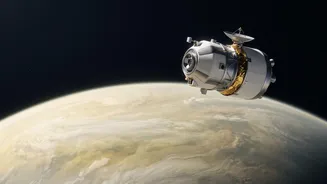
Following the historic successes of its missions to the Moon (Chandrayaan) and Mars (Mangalyaan), ISRO has set its sights on our other planetary neighbour. The mission, named Shukrayaan-1, received formal government approval in September 2024 and is slated
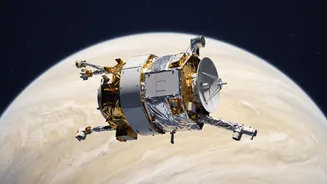
for a launch in early 2028. This ambitious Venus Orbiter Mission will place a 2,500 kg spacecraft into a long, looping orbit around the planet, positioning India among a select group of nations that have explored this challenging world. The journey from Earth is expected to take around 112 days. This endeavour represents a significant step forward, showcasing India's growing capabilities in deep-space exploration and planetary science.
Why Venus? The Mystery of Earth's Lost Twin
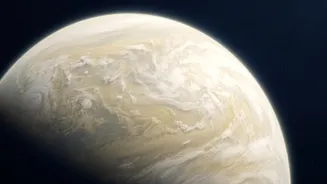
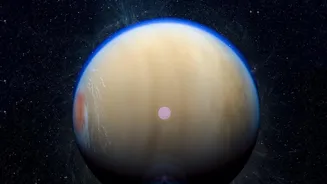
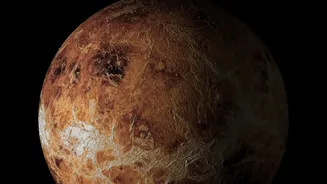
Scientists are fascinated by Venus because it offers a cautionary tale. Despite being similar to Earth in size, mass, and density, it evolved into the most inhospitable planet in our solar system. Venus suffers from a runaway greenhouse effect, with a thick atmosphere composed of over 96% carbon dioxide that traps heat, leading to surface temperatures hot enough to melt lead. Its atmospheric pressure is more than 90 times that of Earth’s, and its skies are filled with dense clouds of corrosive sulphuric acid. By studying why Earth's twin took such a dramatically different path, scientists hope to gain invaluable insights into climate change, atmospheric dynamics, and the conditions that make a planet habitable.
A Chemical Toolkit for a Toxic Sky
The core of Shukrayaan-1's mission is to understand the complex chemistry of the Venusian atmosphere. To do this, it will carry a sophisticated suite of scientific instruments, both Indian and international. A key instrument is a Mass Spectrometer, designed to directly analyse the molecules that make up the planet's atmosphere. This will be complemented by several cameras and mappers operating in different wavelengths. For instance, the Venus Cloud Monitoring Camera (VCMC) will track the planet's thick cloud cover and search for lightning, a phenomenon that could play a role in driving chemical reactions. Another instrument, the Venus Surface Emissivity and Atmospheric Mapper (VSEAM), will study cloud structure and map the distribution of gases like water vapour. These tools will work together to provide a comprehensive picture of the planet's chemical factory.
Decoding the Sulphuric Haze and Searching for Answers
One of the major goals is to understand the life cycle of the sulphuric acid clouds. These clouds are formed when sunlight interacts with sulphur dioxide and other trace gases. Shukrayaan-1 will investigate these photochemical processes in detail. Furthermore, the orbiter will investigate long-standing atmospheric puzzles, such as the mysterious presence of certain chemicals that are difficult to explain. A collaborative instrument developed with French and Russian agencies, known as VIRAL (Venus Infrared Atmospheric Gases Linker), will search for specific trace gases, including phosphine. The tentative detection of phosphine on Venus by other telescopes sparked a global debate, as on Earth the gas is associated with microbial life. While its presence is far from a confirmation of life, Shukrayaan’s instruments will provide crucial data to help solve this and other chemical riddles, like how the planet's upper atmosphere interacts with the constant stream of particles from the Sun.
Beyond the Clouds: Mapping a Hidden World
While atmospheric chemistry is a primary focus, Shukrayaan-1 will also peer through the thick cloud deck to study the planet's surface. It will be equipped with a high-resolution Synthetic Aperture Radar (SAR), which can create detailed maps of the Venusian landscape, searching for signs of active volcanoes and other geological features. In a global first, the mission also plans to carry a ground-penetrating radar to probe beneath the planet's surface. This will provide an unprecedented view of Venus's sub-surface geology, offering clues about its formation and evolution that have remained hidden from all previous missions.