


A Second Look at a Classic View
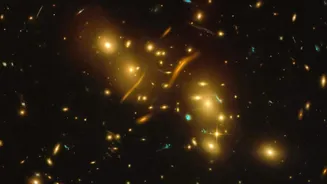
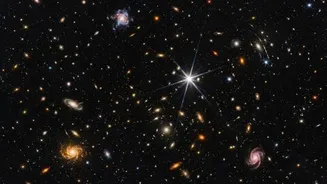
For decades, the Hubble Space Telescope's 'Ultra Deep Field' image has been our most profound window into the early universe. This tiny patch of sky, studied intensely since 2004, revealed thousands of galaxies, giving us a scrapbook of cosmic history.
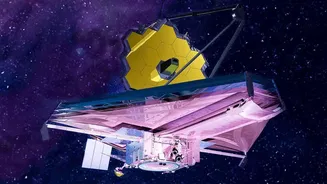
But now, the James Webb Space Telescope (JWST) has turned its more powerful eyes to this same region, and it's seeing it in a completely new light. By revisiting this classic field, astronomers are getting a clearer, deeper, and more detailed picture than ever before, uncovering secrets that were previously hidden in faint, blurry smudges of light.
Unexpected Order in the Chaos
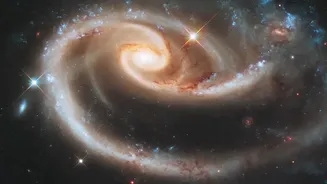
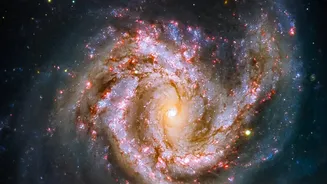
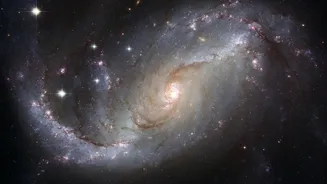
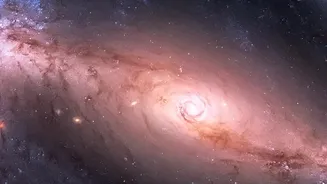
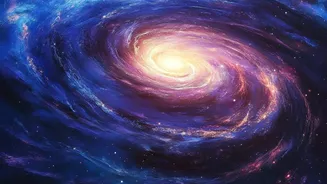
For a long time, the prevailing theory was that the first galaxies in the universe were messy, chaotic collections of stars. The elegant, structured spiral galaxies like our own Milky Way were thought to have taken billions of years to form. Recent JWST observations are challenging this fundamental idea. In data from these deep-field observations, researchers are finding surprisingly mature and well-ordered galaxies that existed much earlier than predicted. One such discovery by Indian researchers even identified a well-formed giant spiral galaxy, nicknamed 'Alaknanda', that existed just 1.5 billion years after the Big Bang, a finding that could change our understanding of how quickly galaxies could get organized.
The Power of Infrared Vision
So how were these details missed for so long? The answer lies in technology. The Hubble telescope primarily sees the universe in visible and ultraviolet light. The James Webb Space Telescope, on the other hand, is optimized to see in infrared. This is a game-changer because the light from the most distant objects in the expanding universe is stretched, or 'redshifted', into these longer infrared wavelengths. Furthermore, infrared light can pierce through the dense clouds of cosmic dust that can obscure visible light. This allows JWST to see not only more distant galaxies but also to resolve the internal structures—like star-forming regions and early spiral arms—that were previously invisible.
Rewriting Cosmic Timelines
Finding 'mature' galaxies in the young universe sends ripples through the field of cosmology. It suggests that the processes of galaxy formation might be much more efficient or happen much faster than our current models account for. These galaxies appear to have large stellar masses and complex chemical compositions that, according to old theories, should have taken billions of years to develop. This doesn't necessarily mean the age of the universe is wrong, but it does force scientists to seriously rethink the early chapters of cosmic history. The discoveries are creating new puzzles, such as how these galaxies grew so big, so fast, and what it implies for the role of dark matter in pulling these early structures together.
What It Means for Us
These discoveries are more than just cosmic trivia; they speak to our fundamental understanding of where everything comes from. The building blocks of planets, and indeed of us, were forged inside stars within galaxies. Understanding how the first galaxies formed and evolved is a critical part of tracing our own cosmic origins. The fact that orderly galaxies may have formed so early suggests the universe was perhaps less chaotic and more capable of creating structured systems from the beginning. It highlights that science is a process of constant refinement, where each new piece of data allows us to sharpen our view of reality.