






The Sun’s Unpredictable Fury
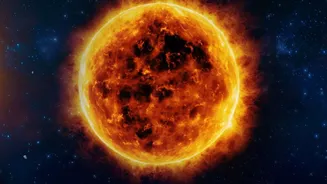
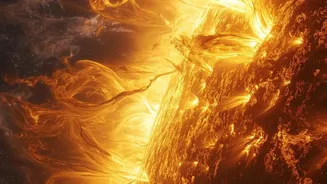
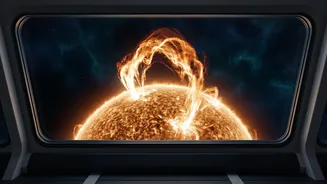
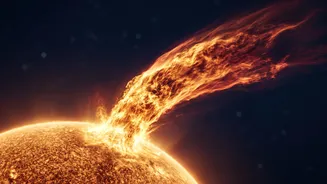
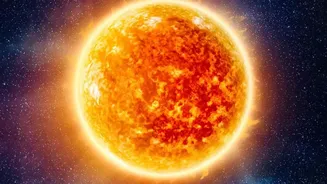
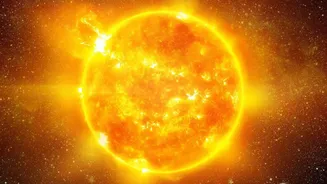
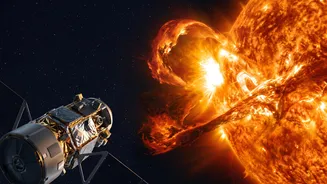
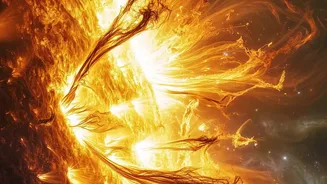
The Sun, the star that sustains all life on Earth, has a volatile side. It occasionally unleashes enormous bursts of energy and plasma called coronal mass ejections (CMEs), or solar storms. When one of these storms heads our way, it’s not just a spectacular
light show like the aurora borealis. These events can induce powerful electrical currents on Earth that can overload power grids, potentially causing widespread and long-lasting blackouts. The consequences could be catastrophic, as seen in the 1989 Quebec blackout which left millions without power for hours. In today’s hyper-connected world, the stakes are even higher. A major storm could fry satellite electronics, disrupt GPS navigation for aviation and shipping, and cripple the communication networks that underpin our global economy.
A Race Against a Cosmic Clock
Until recently, forecasting these events was a slow, challenging process. Scientists could detect a CME when it erupted from the Sun, but predicting its specific impact on Earth was difficult and time-consuming. The warning time was often just hours, providing a narrow window for satellite operators and grid managers to take protective measures. This reactive approach left critical infrastructure vulnerable. The process relied on analyzing data from various satellites, but translating those observations into a specific, localized threat assessment for the entire globe was a major hurdle. In a world where minutes matter, a better, faster system was desperately needed.
Enter DAGGER, The AI Forecaster
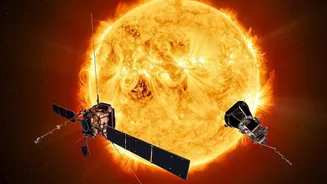
This is where artificial intelligence enters the picture. NASA, in collaboration with public and private partners, has developed a groundbreaking AI model called DAGGER (Deep Learning Geomagnetic Perturbation). This system was trained using deep learning on vast amounts of data from NASA's solar observation missions. By analyzing the constant stream of solar wind data, DAGGER can identify the subtle patterns that precede a geomagnetic disturbance on Earth. Instead of waiting for a human to interpret the data, the AI can make a rapid, global prediction. It can forecast the location and intensity of a solar storm's impact anywhere on the planet with just 30 minutes of advance warning.
From Hours to Minutes
That 30-minute warning is a revolutionary leap forward. While it may not sound like much, it fundamentally changes our ability to defend against space weather. With this early alert, power grid operators have enough time to reroute power or temporarily disconnect sensitive transformers, preventing the kind of damage that could take weeks or months to repair. Satellite operators can put their spacecraft into a protective 'safe mode' to shield delicate electronics. Airlines can reroute flights that would otherwise pass over polar regions, where the effects of solar radiation are strongest. This shift from a slow, general warning to a fast, specific alert system is the core reason NASA is embracing AI for this critical task.
Beyond DAGGER: The Future of Solar AI
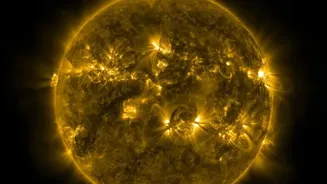
DAGGER is just one example of how AI is transforming heliophysics, the study of the Sun and its influence on the solar system. Another promising AI model developed by NASA and IBM, named Surya, is designed to analyze high-resolution images of the Sun. Trained on years of observations, Surya is learning to predict the emergence of solar flares up to two hours in advance, a significant improvement over existing methods. By making these advanced models open-source, NASA and its partners are encouraging a global community of researchers to help accelerate scientific discovery and build even more resilient systems to protect our technological civilization from the Sun's immense power.