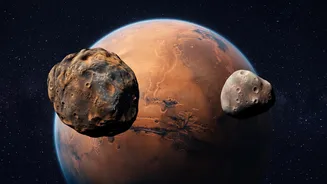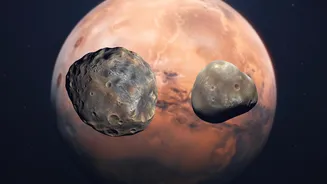


Mars has two tiny, misshapen moons named Phobos and Deimos, which look more like cosmic potatoes than spherical celestial bodies. For decades, scientists have debated their origins, and new analysis is finally shedding light on this Martian mystery.
The Odd Couple of Mars
Unlike
Earth's large, round Moon, the companions to Mars are profoundly strange. Phobos, the larger of the two, is only about 22 kilometres across, while Deimos is a mere 12 kilometres wide. Both are so small that their own gravity is too weak to pull them into a spherical shape, leaving them with the lumpy, irregular forms they likely had when they were created. They are also among the darkest objects in the solar system, covered in dust and loose rock. Phobos orbits incredibly close to Mars, circling the planet three times a day, while Deimos is much farther out. This bizarre arrangement has fueled a long-standing scientific puzzle: are they captured asteroids or are they pieces of Mars itself?
A Tale of Two Theories
For a long time, the leading hypothesis was that Phobos and Deimos were rogue asteroids from the outer solar system that were snared by Mars's gravity. This 'capture theory' makes sense at first glance, as the moons' dark, carbon-rich appearance resembles that of certain primitive asteroids. However, this theory has a major flaw: their orbits. Captured objects would typically have eccentric, tilted orbits, yet Phobos and Deimos circle Mars in neat, nearly circular paths aligned with the planet's equator. This glaring inconsistency led to the development of a rival idea: the 'giant impact' theory. This hypothesis suggests that a massive object, perhaps a protoplanet, slammed into Mars billions of years ago. The resulting debris would have formed a ring around the planet, which then coalesced to form the two moons. This would explain their tidy orbits, but raised questions about their composition, which seemed more asteroid-like than Mars-like.
What New Evidence Reveals
Recent analyses are tipping the scales in favour of the giant impact theory. A fresh look at older data, combined with new observations from probes like the UAE's Hope spacecraft, suggests the composition of the moons may be more similar to the Martian crust than previously thought. While their surfaces look dark like carbonaceous asteroids, new spectral analysis hints that this could be a result of 'space weathering' over billions of years. Beneath this weathered surface, the material could be a mix of debris from Mars and the original impactor. Some studies suggest Phobos and Deimos are essentially 'rubble piles', clumps of debris held loosely together, which is consistent with material coalescing from a debris disk after a major collision. This model neatly resolves the primary conflict: it accounts for both their orderly orbits and their somewhat misleading appearance.
Why Their Origin Story Matters
Solving the mystery of Phobos and Deimos is about more than just curiosity. Understanding how they formed provides a crucial window into the chaotic early days of our solar system. If they are the children of a giant impact, their composition can tell us about the building blocks of Mars itself and the types of collisions that shaped the inner planets, including Earth. It helps us piece together the violent history of planetary formation. This question is so important that the Japan Aerospace Exploration Agency (JAXA) has launched the Martian Moons eXploration (MMX) mission. Scheduled to arrive at Mars in 2027, MMX will orbit, land on, and collect samples from Phobos to be returned to Earth. This will be the first time a sample is returned from the Martian system, and its analysis is expected to provide definitive answers about whether these potato-shaped moons are captured wanderers or native-born children of Mars.