


In a landmark achievement for solar physics, scientists have combined the unique capabilities of India's Aditya-L1 and Europe's Proba-3 missions. This collaboration has yielded the first-ever joint analysis of solar outbursts, offering an unprecedented
view.
Two Missions, One Star
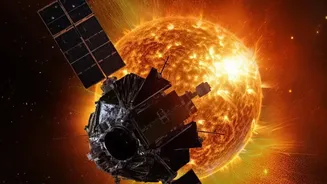
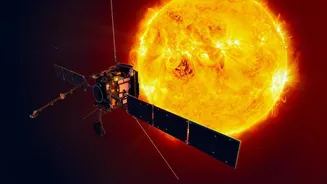
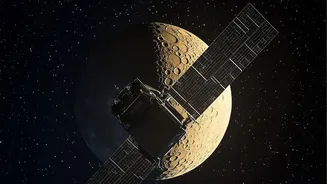
At the heart of this breakthrough are two extraordinary space missions. Aditya-L1 is India's first dedicated solar observatory, a testament to ISRO's growing prowess in space science. Stationed 1.5 million kilometers from Earth at the L1 Lagrange point, it enjoys an uninterrupted view of the Sun. Its suite of instruments includes the Visible Emission Line Coronagraph (VELC), designed to study the Sun's outer atmosphere, or corona. Its partner in this study is the European Space Agency's (ESA) Proba-3, a pioneering mission demonstrating precision formation flying. Proba-3 consists of two satellites flying in a perfect 150-meter alignment, with one casting a precise shadow on the other. This creates a sustained artificial solar eclipse, allowing its ASPIICS coronagraph to see the faint, inner corona with stunning clarity.
Decoding Solar Outbursts
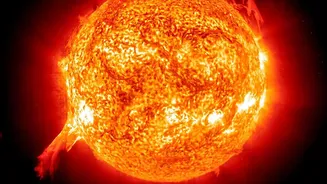
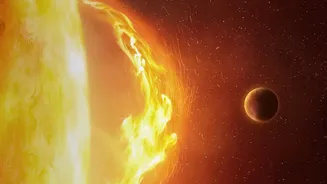
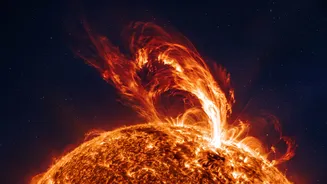
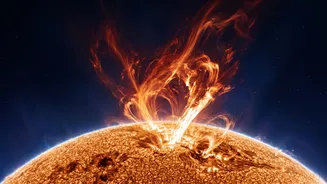
The focus of the joint study was Coronal Mass Ejections (CMEs), which are colossal eruptions of magnetised plasma from the Sun. These solar outbursts can hurl billions of tonnes of material into space at incredible speeds. While beautiful, they are a primary driver of 'space weather'. If a CME is directed at Earth, it can disrupt our magnetic field, damage satellites, cripple communication and navigation systems, and even threaten power grids on the ground. Understanding how they form and accelerate near the Sun is crucial for improving our ability to predict their arrival and potential impact. However, observing the very early stages of these eruptions has always been a major challenge for scientists because the Sun's blinding glare obscures the faint coronal structures where they are born.
A Symphony of Data
This is where the synergy between Aditya-L1 and Proba-3 becomes revolutionary. The two missions essentially bridge a critical observational gap. Proba-3's ASPIICS instrument, thanks to its artificial eclipse, provides exceptionally sharp images of a CME's shape, mass, and movement as it leaves the Sun. Meanwhile, Aditya-L1's VELC instrument performs spectroscopy, analysing the light from the corona to independently measure the plasma's density, temperature, and thermal energy. By combining the imaging data from ASPIICS with the spectroscopic data from VELC for the same event, scientists can build a much more complete, three-dimensional picture of a CME's evolution than either mission could achieve alone. The first published analysis examined two CMEs observed in September 2025.
What the First Analysis Revealed
The initial findings, published by a team led by the Indian Institute of Astrophysics (IIA), revealed two distinct eruption behaviours. One CME, observed on September 14, 2025, was fast, travelling at roughly 645 km/s. The other, from September 16, was much slower, at around 145 km/s. The slower CME's density dropped off more sharply, indicating it expanded more powerfully in its early stages. Critically, the mass and energy estimates derived independently from both VELC and ASPIICS showed strong agreement, validating the power of this combined approach. The analysis also revealed how the energy balance—between kinetic (motion), thermal (heat), and magnetic—shifted as the eruptions evolved, a key piece of the puzzle for understanding space weather.