




A Glimpse of a 'Hycean' World
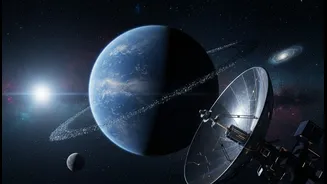
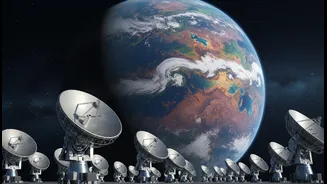
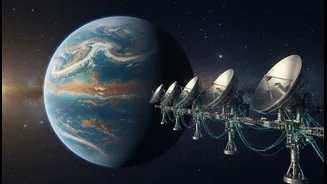
Located 124 light-years away in the constellation Leo, K2-18b is an exoplanet about 8.6 times the mass of Earth. What makes it special is its position in the habitable zone of its star, where conditions might be right for liquid water to exist. Observations
from the James Webb Space Telescope (JWST) revealed carbon dioxide and methane, strengthening the theory that K2-18b could be a "Hycean" world—a hypothetical type of planet with a global liquid-water ocean beneath a thick hydrogen-rich atmosphere. This tantalizing possibility makes it one of the most compelling targets in the search for life beyond our solar system.
Hunting for a Chemical Fingerprint
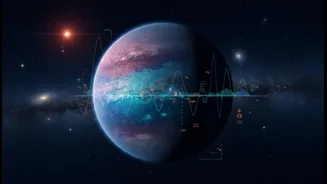
To study a world so distant, astronomers use a technique called transit spectroscopy. As K2-18b passes in front of its host star, a tiny fraction of the starlight filters through the planet's atmosphere before reaching the James Webb Space Telescope. The gases in that atmosphere absorb specific frequencies of light, leaving a chemical fingerprint in the spectrum that JWST can read. Scientists analyze these fingerprints, or spectra, to identify the molecules present, searching for potential "biosignatures"—gases that, on Earth, are produced by living organisms.
The Excitement Over Dimethyl Sulfide
In 2023, the search yielded a thrilling result. A team of researchers announced they had found a possible hint of dimethyl sulfide (DMS) in K2-18b's atmosphere. This caused a stir because on Earth, DMS is almost exclusively produced by life, primarily marine phytoplankton. The potential presence of this molecule, combined with the earlier detection of methane and the absence of other gases like ammonia, seemed to fit the profile of a Hycean ocean world. For a moment, it seemed we had the strongest clue yet of biological processes on another world.
The Art of Filtering Signal From Noise
Pinpointing a specific gas from 124 light-years away is an immense technical challenge. The atmospheric signal is incredibly faint, buried within the light of a star and distorted by instrumental noise. To find it, astronomers use sophisticated computer models to simulate what the planet's spectrum should look like with different combinations of gases. They then compare these models to the actual data collected by the telescope to see which one provides the best fit. The original team found that a model including DMS seemed to explain the data better than a model without it. This process of modeling and comparison is the first, crucial step in filtering a potential discovery from random noise.
A Story of Scientific Debate
Science, however, relies on verification. Following the initial announcement, several other independent research groups accessed the same public JWST data and performed their own analyses, a critical part of the scientific process. Their conclusions were different. Some studies argued that the DMS signal was not statistically significant enough to be considered a genuine detection. Others proposed that the faint dip in the spectrum could be explained by another molecule entirely, or that it might be the result of unresolved instrumental noise from the telescope itself. As of early 2026, the scientific community remains divided, with many concluding there is not yet compelling evidence for DMS on K2-18b.
So, Is It Life? Not Yet
The controversy surrounding K2-18b does not represent a failure, but rather the scientific method working as intended. Extraordinary claims require extraordinary evidence, and the bar for announcing the discovery of extraterrestrial life is justifiably high. The process of claim, verification, and debate is precisely how science filters credible signals from false positives. Even if the DMS signal evaporates under further scrutiny, the debate itself is invaluable. It pushes scientists to refine their analytical techniques, better understand the limits of their instruments, and clarify what would constitute undeniable proof of life.