





The Icy Recipe for Rings
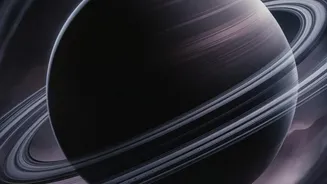
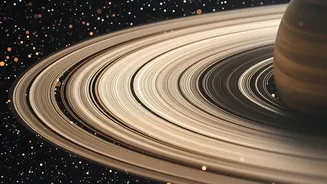
First, it helps to know what planetary rings are actually made of. While they might look solid from millions of kilometres away, they are vast, orbiting collections of countless individual particles. The most spectacular and well-known rings, like Saturn’s,
are composed almost entirely of water ice, with a smaller mix of rock and dust. These icy chunks can range from the size of a tiny dust grain to as large as a mountain. This composition is key; ice is highly reflective, which is why Saturn's rings are so bright and visible, whereas the darker, dustier rings of Jupiter or Uranus are much harder to see.
The Sun's 'Frost Line'
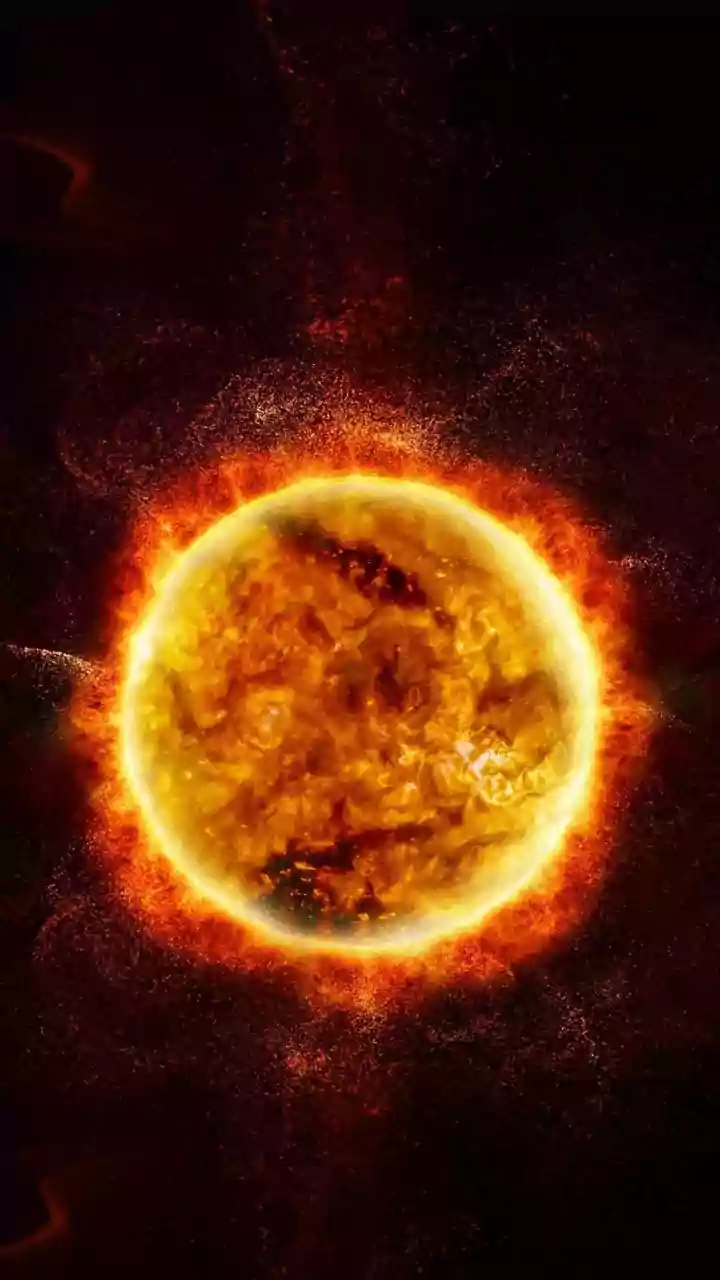
Every solar system has a critical boundary known as the 'frost line' or 'snow line'. Think of it as a circular line drawn around a star. Inside this line, the star's heat is too intense for volatile compounds like water, methane, and ammonia to freeze into solid ice. Any ice in this warmer zone is quickly turned into gas. Outside the frost line, it's cold enough for these materials to condense and remain as solid ice particles. In our solar system, this line falls somewhere in the asteroid belt, between the orbits of Mars and Jupiter. This fundamental divide explains why the inner planets (Mercury, Venus, Earth, and Mars) are rocky, while the outer planets are gas and ice giants.
Sublimation: Ice to Gas in an Instant
The primary process that prevents icy rings from surviving in the inner solar system is sublimation. This is what happens when a solid, like ice, turns directly into a gas without ever becoming a liquid. In the near-vacuum of space, this happens to ice when it's exposed to enough energy, like direct sunlight. Inside the frost line, the sun’s radiation is powerful enough to constantly blast any orbiting ice particles. Instead of melting, these particles would simply sublimate, turning into water vapour that is then swept away by the solar wind. An icy ring system close to the sun would essentially evaporate into space before it could ever establish itself.
The Right Place, The Right Time
For rings to form, debris needs to orbit a planet inside a specific boundary called the Roche limit. This is the distance within which the planet’s gravity is so strong that it rips apart larger bodies like moons or comets, preventing them from clumping together. The debris then spreads out to form a ring. So, a ring needs to be close to its planet. However, for the inner planets, this entire Roche limit zone is located well inside the sun's frost line. This creates a cosmic catch-22: any icy moon or comet that got close enough to Earth or Mars to be torn into a ring would also be in a region where the sun’s heat would rapidly destroy those icy fragments through sublimation.
What About Rocky Rings?
If ice is the problem, could the inner planets have rings made of rock? It's theoretically possible, and some scientists believe Earth may have had a temporary rocky ring in its distant past. However, there are a few challenges. Firstly, the outer solar system, where the giant planets formed, simply had far more icy material available. Secondly, the giant planets have much stronger gravity and many more moons, creating more opportunities for the kinds of collisions or tidal disruptions that generate ring debris. Jupiter's faint rings, for instance, are thought to be constantly replenished by dust kicked off its inner moons by micrometeoroid impacts.
Even Saturn's Rings Aren't Forever
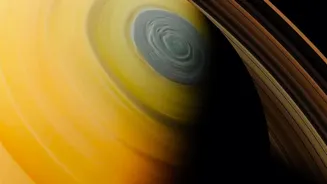
The existence of rings is a delicate balance, and even Saturn's glorious system is not permanent. NASA research has confirmed that the rings are disappearing. A phenomenon dubbed 'ring rain' is pulling icy particles from the rings down into Saturn's atmosphere under the influence of the planet's gravity and magnetic field. Scientists estimate that based on this process, the rings could be completely gone in less than 100 million years — a relatively short time in the 4.5-billion-year history of the solar system. This discovery reinforces the idea that planetary rings are transient, beautiful features that require very specific conditions to exist.