




Elon Musk's prediction that nearly 100% of future AI computing will happen in space captures a bold vision for humanity. But between the dream of orbital data centres and reality lies a minefield of physics and engineering problems.
Why Move Computing to Space?
The push for off-Earth
data centres is driven by very terrestrial problems. The voracious energy appetite of artificial intelligence is straining power grids, with demand projected to more than double by 2030. In many areas, getting a new data centre connected to the grid can take years, creating a significant bottleneck for AI development. Proponents like Musk, and even competitors like Google and Amazon's Jeff Bezos, see space as a solution. In orbit, massive solar arrays can collect near-continuous, powerful sunlight, bypassing earthly energy constraints. The goal is to build the infrastructure for 'superintelligence' and a future of abundance, where AI-driven robots and services are widely available. For a self-sustaining Mars colony, local high-performance computing would be essential, not just a convenience.
The Cooling Conundrum
On Earth, data centres use air and water to dissipate the immense heat generated by processors. In the vacuum of space, that's not an option. With no air for convection, heat must be removed through conduction—transferring it through solid materials—and then radiated away into space. This is a far less efficient process. Any space-based data centre would require massive radiators and complex thermal management systems to prevent processors from overheating and failing. Every component, from power supplies to the processors themselves, needs a dedicated physical path to shed heat. This adds significant weight, complexity, and cost to any satellite design, a challenge that companies like Google have identified as a major hurdle in their own orbital computing research.
The Radiation Hurdle
Beyond the protection of Earth's atmosphere and magnetic field, electronics are bombarded by a constant stream of high-energy cosmic and solar radiation. These particles can cause a range of problems, from 'bit-flips' that corrupt data to short circuits that can permanently destroy components. This is why spacecraft like the Mars rovers use specially 'radiation-hardened' processors, which are vastly slower and more expensive than their consumer-grade counterparts. The Perseverance rover, for instance, uses a processor with the same architecture as a 1998 iMac, chosen for its reliability over raw speed. While modern AI requires cutting-edge chips, these are incredibly vulnerable to radiation. Shielding helps, but it can't block everything and adds launch mass, which directly increases costs.
Power, Cost, and Maintenance
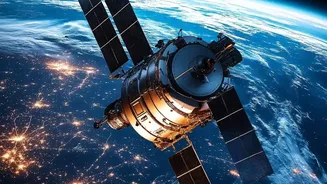
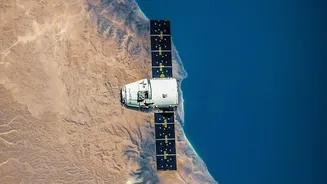
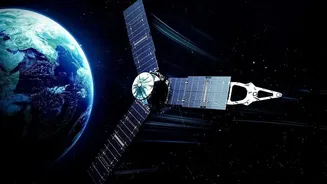
While solar power is abundant in space, harnessing it for a gigawatt-scale data centre is a monumental task. It requires huge solar arrays, batteries for when the satellite is in Earth's shadow, and robust power systems. Furthermore, the cost is astronomical. One analysis suggests a 1GW orbital data centre could cost over three times as much as a terrestrial one, with launch expenses making up the bulk of the investment. SpaceX itself has sought approval for a constellation of up to one million satellites to function as data centres, an undertaking of unprecedented scale. Finally, there's the issue of maintenance. On Earth, failed servers are simply replaced. In orbit, repair missions are impractical for a large constellation. Systems must be designed with extreme redundancy and the expectation that some hardware will fail without any chance of a fix.