









The Challenge of a Cloudy Sky
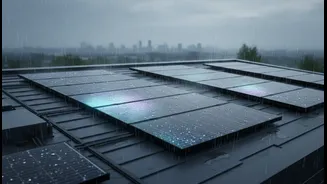
Conventional solar panels are at their best under a clear, sunny sky. They rely on direct sunlight, where photons—or light particles—strike the silicon cells and get converted into electricity. When clouds roll in, they scatter the sunlight, creating
what is known as diffuse light. While modern panels can still generate some power from this, their output drops dramatically. On a heavily overcast day, a standard solar panel might only produce 10% to 30% of its peak capacity. This variability is a major headache for grid managers and a significant barrier to relying on solar power as a primary energy source, particularly in regions with long rainy seasons or frequent cloud cover.
A Breakthrough in Reflective Design
Now, a Canadian startup called Reflect10 has unveiled a novel panel architecture that tackles this problem head-on. Instead of focusing solely on improving the efficiency of the photovoltaic cells themselves—a field where progress is approaching its theoretical limits—this new design rethinks the panel's structure. It embeds a unique light-reflecting geometry directly into the module. This isn't about placing external mirrors around the panel, which is an older, more cumbersome approach. Instead, the innovation is built right into the panel, designed to capture and redirect light that would otherwise be lost.
Giving Light a Second Chance
The concept is ingeniously simple: give each photon more opportunities to be converted into electricity. In a standard panel, a photon of light gets one pass. If it doesn't get absorbed by a solar cell, its energy is wasted. The new design uses its internal reflective surfaces to bounce incoming light around inside the panel. This multi-reflection approach is especially effective for light that comes in at low angles, such as during the early morning and late afternoon, or for diffuse light on cloudy days. By trapping light for longer, the panel significantly increases the chances of absorption. The company claims this can boost average daily energy production by up to 20% and generate nearly 2.7 times more power during low-light hours.
A Game-Changer for India’s Monsoon
For India, the implications of this technology are enormous. The country has ambitious solar energy targets, but the annual monsoon season, which can last for months, creates a significant dip in solar generation. A panel that performs better in diffuse light could make solar power a much more reliable year-round energy source across the subcontinent. It would help stabilize the energy grid, reduce reliance on fossil fuels during cloudy months, and make solar installations more economically viable in areas that were previously considered less than ideal. Consistent energy generation means better energy security and a smoother transition to renewables.
Part of a Bigger Innovation Wave
This new reflective architecture joins a growing family of technologies aimed at boosting solar performance in real-world conditions. It complements existing innovations like bifacial panels, which capture reflected light from the ground on their rear side, and half-cut cells, which reduce power loss from partial shading. Monocrystalline panels, known for their high efficiency, already offer better low-light performance than their polycrystalline counterparts. However, by fundamentally changing how the panel manages light internally, this new design represents a distinct and important step forward, focusing on the panel's overall structure rather than just the cells within it.
The Path to Your Rooftop
While this breakthrough is exciting, it's important to manage expectations. The technology is currently at the startup and prototype stage, and it will take time for it to be tested, scaled up for mass manufacturing, and made commercially available. Innovations in the solar industry must prove their durability, reliability, and cost-effectiveness over years of use before they become mainstream. However, with conventional silicon cells nearing their maximum possible efficiency, such architectural innovations are precisely where the next big gains in solar power will come from. This design offers a glimpse into a future where solar panels are no longer just passive collectors of light, but smart systems designed to actively manage every photon.