






The Soul of the Snake Boat
The Chundan Vallam, or snake boat, is more than just a vessel; it is an icon of Kerala's culture. Its history stretches back to the 14th century, when a king commissioned a new type of war canoe, long and slender, to outpace his enemies in the region's
labyrinthine waterways. When the wars ended, these remarkable boats were reborn as the centrepiece of Vallam Kali, the spectacular boat races held during the Onam festival season. Each boat traditionally belongs to a village, worshipped like a deity and imbued with a deep sense of community pride. This connection transforms the boat from a simple sporting object into a living piece of heritage, a vessel carrying the spirit of its people.
An Unwritten Blueprint
The construction of a Chundan Vallam rarely begins with a detailed paper blueprint. Instead, it starts in the mind of the 'Moothashari', the master carpenter. This knowledge, passed down through generations, is a complex blend of mathematics, engineering, and pure intuition. The Moothashari holds the boat's form—its precise length, width-to-length ratio, and the subtle curvature of its hull—as an inherited secret. Construction begins on an auspicious day, with the selection of the perfect Anjili (wild jackfruit) tree, a timber known for its resistance to water and rot. Every step is guided by oral traditions, sometimes referencing the 'Sthapatya Veda', an ancient treatise on wooden construction, ensuring the boat is built not just with skill, but with reverence.
The Art of the Hull
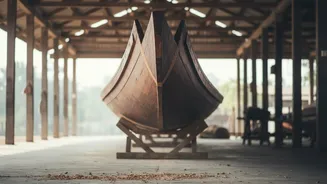
The secret to a snake boat's blistering speed lies in its extreme, needle-like shape. Stretching up to 138 feet long but often only a few feet wide, the hull is designed to slice through water with minimal drag. The master builder oversees the joining of long wooden planks, often with traditional joints and iron bolts that allow the hull a slight flex. This flexibility is crucial; it prevents the enormous stress of over 100 rowers from cracking the frame. The customisation happens here, in the subtle adjustments made by the builder. A slight change in the curvature, the height of the stern, or the balance can mean the difference between winning and losing. The famous raised prow, which gives the boat its 'snake' moniker, isn't just for show; it helps balance the vessel during turns and prevents the long body from dipping.
Ritual for Reducing Drag
Months of construction culminate in the final, crucial preparation rituals before a race. This is where ancient knowledge directly translates into speed. The hull of the boat is meticulously coated with a special mixture, a guarded recipe that typically includes fish oil, carbon from burnt coconut shells, and eggs. This potent, oily concoction serves a dual purpose. Firstly, it acts as a waterproof sealant, preventing the wood from absorbing water and becoming heavy during a race. Secondly, and more critically for speed, it creates an incredibly slick, lubricious surface. This polishing drastically reduces the hull's friction as it moves through the water, allowing the Chundan Vallam to glide with maximum efficiency, turning the raw power of its rowers into breathtaking velocity.