





India’s Unblinking Eye on the Sun
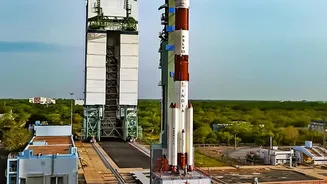
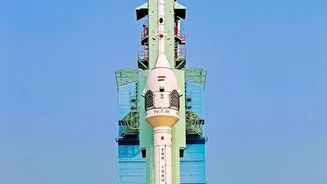
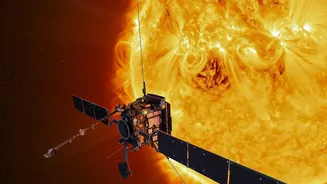
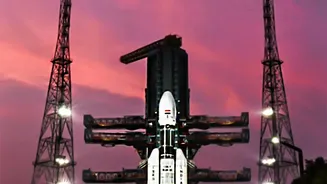
Launched by the Indian Space Research Organisation (ISRO), Aditya-L1 is India's first space-based observatory dedicated to studying the Sun. It holds a unique position in space, orbiting at the first Lagrange point (L1), about 1.5 million kilometres from
Earth. This strategic location allows the spacecraft to watch the Sun continuously, without any interruptions from eclipses or Earth's shadow. It’s like having a permanent, front-row seat to the greatest show in the solar system. This constant vigilance is crucial for monitoring the Sun's activity and spotting the early signs of potentially dangerous space weather events.
The Fury of a Solar Storm
So, what exactly is this “solar weather” that astronomers are so concerned about? The primary threats are solar flares and Coronal Mass Ejections (CMEs). Solar flares are immense bursts of electromagnetic radiation, while CMEs are massive clouds of magnetised plasma hurled into space. When directed at Earth, this solar fury can have serious consequences. These events can disrupt satellite operations, scramble GPS signals, create blackouts in radio communications, and even damage power grids on the ground. In our increasingly connected world, the ability to forecast these storms is not just a scientific curiosity—it's a matter of global security and economic stability.
The Payloads Making the Difference
Aditya-L1 is equipped with seven sophisticated instruments, or payloads, each designed to study a different aspect of the Sun. Four of these are remote-sensing payloads that observe the Sun's atmosphere, while three are in-situ instruments that measure the space environment at the L1 point. The stars of the show for storm tracking are payloads like the Solar Ultraviolet Imaging Telescope (SUIT) and the Visible Emission Line Coronagraph (VELC). SUIT captures high-resolution images of the Sun's lower and middle atmosphere in near-ultraviolet wavelengths, a range that is largely invisible from the ground. VELC is designed to observe the Sun's corona, its outermost layer, by blocking the bright light from the solar disk, allowing it to see the much fainter activity happening around it.
A New Era in Solar Forecasting
The data from Aditya-L1 is already proving to be a game-changer. Scientists using data from SUIT, along with the X-ray spectrometers SoLEXS and HEL1OS, have discovered small, short-lived brightenings that appear hours before a major solar flare erupts. These 'pre-flare transients' seem to cluster around the very spot where the larger eruption will occur, acting as an early warning sign. By combining observations across different wavelengths, from UV to X-rays, researchers can create a more complete picture of the energy buildup that leads to a violent solar outburst. These insights are a crucial step toward creating more reliable forecasts for space weather.
A Global Effort for a Global Threat
The data gathered by Aditya-L1 isn't just for Indian scientists. ISRO has made the science-ready data from the mission publicly available to the global scientific community. Researchers from around the world can now access this information, combining it with data from other solar observatories, like those from NASA and the European Space Agency, to build more comprehensive models of solar activity. This collaborative approach is vital, as a major solar storm is a global threat that requires a united response. Recent studies have involved researchers from international institutions like Germany's Max Planck Institute, demonstrating the mission's growing global impact. Aditya-L1's contributions are helping to improve our collective understanding of the Sun and how to protect our planet from its most extreme moods.