



What is the Goldilocks Zone?
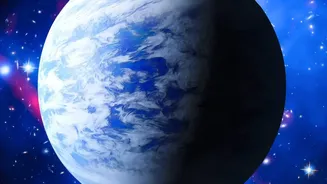
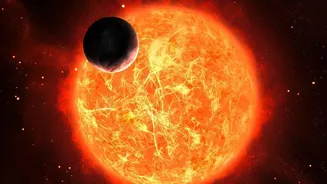
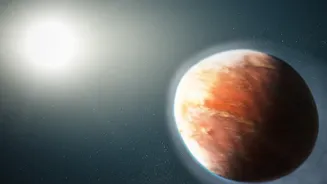
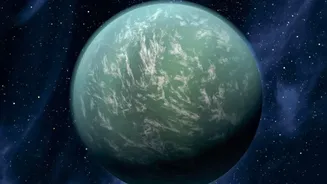
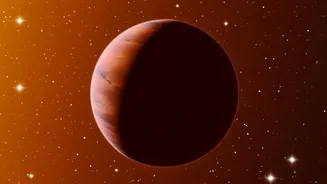
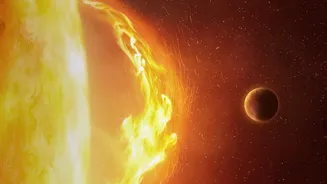
In astronomy, the habitable zone, more charmingly known as the Goldilocks Zone, is the orbital region around a star where conditions are neither too hot nor too cold for liquid water to exist on a planet's surface. If a planet is too close to its star,
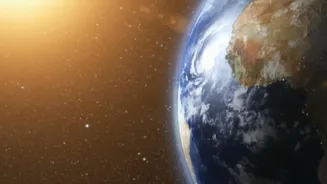
its water will boil away into steam; too far, and it will freeze into solid ice. The size and location of this zone depend entirely on the star itself. Hotter, larger stars have wider habitable zones that are farther out, while cooler, dimmer stars like red dwarfs have much tighter habitable zones closer in. Our own Earth orbits comfortably within the Sun's Goldilocks Zone, a fact that is fundamental to the existence of life as we know it. This 'just right' positioning is the first and most critical filter astronomers use when sifting through the thousands of known exoplanets to identify potential candidates for harbouring life.
Searching for Life's Fingerprints
Finding a planet in the habitable zone is just the first step. The next is to search for biosignatures—substances, patterns, or phenomena that provide evidence of past or present life. These are not alien fossils or structures, but subtle clues hidden in a planet's atmosphere. Think of them as chemical fingerprints left behind by biological processes. The most sought-after biosignatures are certain gases that, in specific combinations, are hard to explain without biology. On Earth, for example, the simultaneous presence of abundant oxygen and methane is a strong indicator of life, as these gases would normally react with and destroy each other. Their continued coexistence implies they are being constantly replenished, a task performed on our planet by living organisms. Detecting these gases involves analysing the starlight that filters through an exoplanet's atmosphere, a technique called transmission spectroscopy.
The Crucial Role of Liquid Water
The reason the Goldilocks Zone is paramount to finding biosignatures comes down to one essential ingredient: liquid water. Life as we understand it requires a solvent, a medium in which the chemical reactions necessary for metabolic processes can occur. Water is an exceptional solvent because of its polar nature, allowing it to dissolve other substances and transport nutrients and waste within cells. Planets within the habitable zone are the most likely to have stable liquid water on their surfaces. This watery environment is the presumed stage where life might emerge and thrive, creating and releasing the very biosignature gases that scientists are searching for. Without liquid water, the complex chemistry that underpins biology would likely never get started, meaning no life and therefore no detectable biosignatures. The search for these chemical fingerprints is, fundamentally, a search for worlds with water.
Technology and the Tremendous Challenge
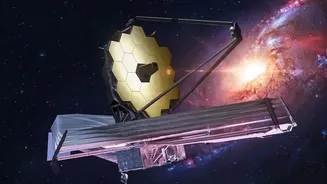
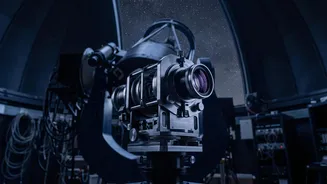
Identifying these tell-tale signs of life across light-years of space is an immense technological challenge. The signals are incredibly faint, and there is a significant risk of 'false positives'—where geological or non-biological chemical processes can mimic a biosignature. For instance, oxygen can be produced without photosynthesis under certain atmospheric conditions. This is where groundbreaking technology like the James Webb Space Telescope (JWST) comes in. With its unprecedented sensitivity, JWST can analyse the composition of exoplanet atmospheres with greater detail than ever before, detecting molecules like methane, carbon dioxide, and water vapour. While JWST has not yet definitively detected a biosignature, its observations are refining our understanding of planetary atmospheres and helping scientists distinguish between potentially living worlds and merely interesting geology. The goal is not just to find one gas, but a specific atmospheric imbalance that strongly points to biology as the most likely explanation.