








What Exactly Is Aphelion?
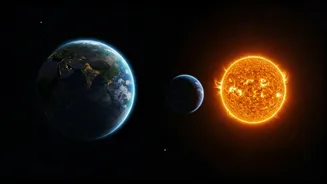
Earth’s journey around the Sun isn't a perfect circle; it’s a slightly oval-shaped path called an ellipse. This means our distance from the Sun changes throughout the year. Aphelion is the specific point in this orbit when Earth is at its maximum distance from the Sun.
In 2026, this occurs on July 6, when we will be about 94.5 million miles away from our star. The opposite of this event is perihelion, which happens in early January, when Earth is closest to the Sun. The difference between these two points is nearly 5 million kilometres. It seems logical to think that farther should mean colder, but as the July temperatures demonstrate, there's more to the story.
The Myth of Distance
A common misconception is that our seasons are caused by the changing distance between Earth and the Sun. While a 5-million-kilometre difference sounds massive, it has a surprisingly small effect on our planet's overall temperature. The variation in solar energy we receive between aphelion and perihelion is only about 7%. This minor change is not powerful enough to dictate our seasons. In fact, the entire planet is actually slightly warmer on average during aphelion in July than during perihelion in January. This is because the Northern Hemisphere, which has more landmass that heats up easily, is tilted toward the Sun at this time. The real driver behind summer heat and winter cold lies not in our distance from the Sun, but in our planet's tilt.
The Real Reason for Seasons: Earth's Tilt
The secret to our seasons is Earth's axial tilt. Our planet spins on an axis that is tilted at an angle of about 23.5 degrees. This tilt remains constant as we orbit the Sun. What changes is which part of the planet is angled toward the Sun. During June and July, the Northern Hemisphere, which includes India, is tilted toward the Sun. This tilt means that sunlight hits our part of the world more directly, almost like a flashlight shining straight down. This direct concentration of energy over a smaller area results in more intense heating and the warmer temperatures of summer. The days are also longer, giving the Sun more time to warm the land and air.
Direct vs. Indirect Sunlight
When the Northern Hemisphere is tilted towards the Sun, the Southern Hemisphere is tilted away, experiencing winter. There, the Sun's rays arrive at a shallower angle, spreading the same amount of energy over a much larger area, which leads to cooler temperatures. The opposite happens in December and January. Even though the Earth as a whole is closer to the Sun (perihelion), the Northern Hemisphere is tilted away. The indirect, spread-out sunlight and shorter days lead to winter, while the Southern Hemisphere enjoys its summer. So, the heat you feel in July isn't about proximity; it’s about receiving the Sun's most powerful, direct rays.
India's July Weather: A Mix of Heat and Rain
For India, July is a complex month where this astronomical reality meets the powerful force of the monsoon. While the Northern Hemisphere's tilt ensures high solar energy, July is also the peak of the rainy season for most of the country. The cloud cover and rainfall bring some relief from the intense dry heat of May and June, but average temperatures remain high, often around 30°C, with significant humidity. The combination of the Earth's tilt providing strong solar radiation and the atmospheric conditions of the monsoon creates the characteristically hot, humid, and wet weather experienced across much of the subcontinent during this time.