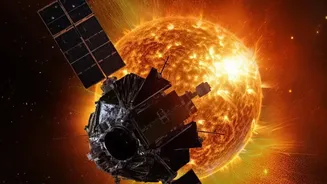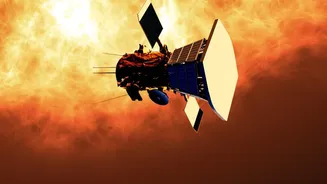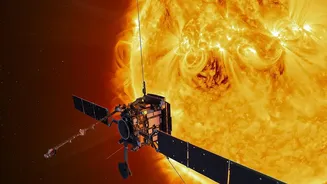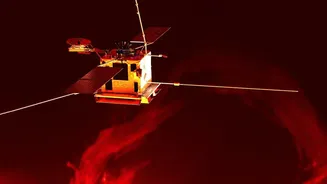





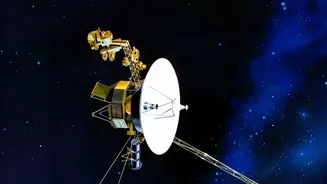

A Gravitational Sweet Spot
The destination for Aditya-L1 is no ordinary patch of space. It's called Lagrange Point 1, or L1. In any two-body system, like the Sun and Earth, there are five of these special points where the gravitational forces of the two large bodies and the centrifugal
force on a smaller object balance each other out. Think of L1 as a kind of gravitational equilibrium point located on the line between the Sun and Earth. For a spacecraft like Aditya-L1, this means it can 'park' in a stable position relative to both, significantly reducing the amount of fuel needed for station-keeping over its five-year mission.
The Unbroken Gaze: A Constant View
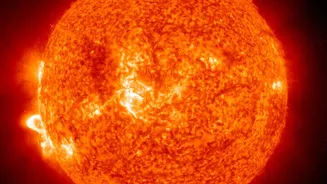
The single biggest advantage of the L1 point is the ability to watch the Sun continuously. Unlike observatories in low-Earth orbit (LEO), Aditya-L1 will never have its view blocked. A satellite orbiting Earth would periodically pass into our planet's shadow, creating an eclipse that interrupts crucial data collection. From its perch at L1, Aditya-L1 has a permanent, front-row seat to our star's activities, 24/7. This constant stream of observation is essential for studying dynamic events like solar flares and coronal mass ejections (CMEs) from start to finish.
Why Not Just Orbit the Earth?
Initially, the mission, then called Aditya-1, was planned for a low-Earth orbit. However, besides the problem of Earth blocking the view, a LEO mission would also be hampered by Earth's magnetic field. Several of Aditya-L1's key instruments are designed to study the solar wind—a stream of charged particles flowing from the Sun. By placing the spacecraft at L1, far outside Earth's magnetosphere, it can sample the solar wind in its pristine state, before it interacts with our planet's magnetic environment. This allows for a much cleaner and more direct analysis of the Sun's output.
A Stable Platform for Precision Science
Studying the Sun requires incredible precision. The L1 point offers a very stable thermal environment and a smooth velocity change as the spacecraft orbits the point, which is beneficial for sensitive instruments. For helioseismology—the study of the Sun's interior through its surface vibrations—this stability is crucial. Furthermore, the constant distance from the Sun ensures that the data collected by its seven sophisticated payloads is consistent, without variations caused by a changing proximity to the star. This allows scientists to more accurately compare solar phenomena over time.
An Early Warning System for Space Weather
The L1 point acts as an upstream sentry for Earth. Any solar storm or burst of high-energy particles heading towards our planet will pass by Aditya-L1 first. This gives scientists a vital early warning, providing crucial time to protect our satellites, communication networks, and power grids from the disruptive effects of space weather. The spacecraft's instruments, like the Solar Wind Ion Spectrometer (SWIS) and Plasma Analyser Package for Aditya (PAPA), are designed to measure the properties of these solar emissions directly, giving us a heads-up on what's coming our way.