





The Old Way: Robots on Rails
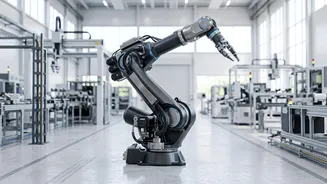
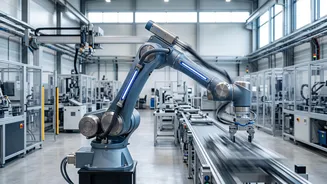
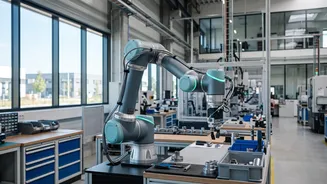
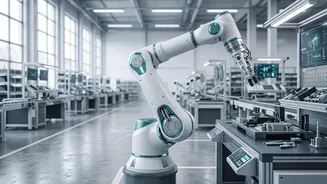
Think of a classic robot on an assembly line. It welds, paints, or lifts with incredible precision and speed, but it follows a fixed, pre-programmed path. This is the world of 'fixed motion' robotics. These machines are the workhorses of modern manufacturing,
optimised for repetitive tasks in a controlled environment. If a part is misplaced by even a few millimetres, the robot can't adapt; it will continue its programmed sequence, often leading to errors or shutdowns. This limitation has kept robots from performing more delicate or unpredictable jobs that require a sense of adaptability—tasks that, until now, have been left to human hands.
Eka's Leap: From Programming to Intuition
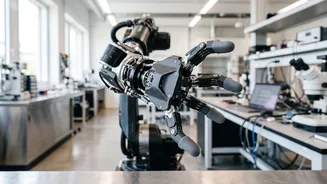
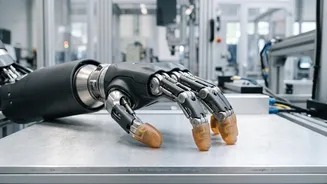
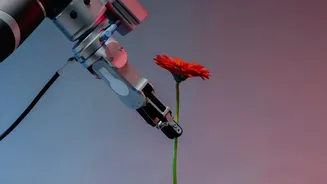
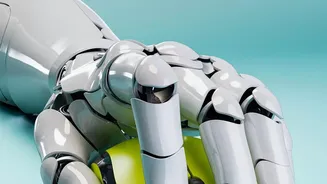
Eka Robotics is moving beyond this rigid model. The company's new focus is on creating robots that can handle the unpredictability of the real world by developing a form of physical intuition. Instead of just following code, Eka's systems are built on what it calls a Vision-Force-Action (VFA) model. This 'physical AI' combines camera vision with advanced force sensors in the robot's gripper. In simple terms, the robot doesn’t just see an object; it feels it. This allows it to determine how much pressure to apply when grasping a delicate fruit versus a heavy metal part, a critical step towards more general-purpose robots.
Training Robots in a Virtual World
The secret to teaching a robot how to 'feel' is not by programming every possible scenario, but by letting it learn through experience. Eka achieves this at a massive scale by using reinforcement learning in a simulated environment. In these virtual worlds, the robot can practice millions of manipulation tasks in just hours, experimenting with different objects, environments, and physical conditions. This process is similar to how a video game character learns to navigate its world through trial and error. By mastering physics in simulation first, the robot develops an understanding that can be transferred to the real world, overcoming the historic 'sim-to-real' gap that has long challenged roboticists.
Superhuman Performance and Market Potential
The results are already showing superhuman capabilities. Eka's robots can reportedly perform around 1,500 pick-and-place operations per hour with over 95% accuracy, more than double the average human rate of 600. This leap in performance has attracted significant investor attention, leading to a recent $150 million funding round that values the company at $1.45 billion. The technology opens up new frontiers beyond traditional factory automation, targeting logistics, e-commerce fulfillment, and even complex assembly tasks that require fine motor skills, like inserting wires or screwing in lightbulbs. For India's booming manufacturing and supply chain sectors, this kind of adaptable automation could be a game-changer.
India's Growing Robotics Ambition
Eka's pivot is part of a broader trend within India's burgeoning robotics ecosystem. Startups like Addverb, Unbox Robotics, and Ati Motors are increasingly moving from software services to building sophisticated hardware and AI-driven solutions. This new generation of companies is tackling challenges in warehouse automation, manufacturing, and logistics, fueled by a deep pool of engineering talent and growing venture capital interest. They are positioning India not just as a market for automation, but as a creator of the core technology that will power the next generation of intelligent machines globally. While challenges remain in scaling from lab demos to reliable, long-term industrial deployment, the ambition is clear.