





The Philosophy of Slow Movement
Before diving into the exercises, it’s important to understand why 'slow' is the focus. When muscles are stiff, fast or forced stretches can sometimes cause them to tighten up even more as a protective reflex. Slow, controlled movements, however, improve
circulation and joint mobility without triggering this response. This method, often called 'time under tension', allows you to focus on proper form, which prevents injury and helps retrain your body to move without pain. The goal is to feel a gentle release, not a sharp pull. Think of it as coaxing your muscles to relax, not forcing them.
1. Gentle Neck Tilts
Neck stiffness is one of the most common complaints from office workers. To gently release this tension, sit tall with your shoulders relaxed and away from your ears. Slowly tilt your right ear toward your right shoulder, stopping as soon as you feel a light stretch along the left side of your neck. Never pull your head down or force the movement. Hold the position for 15-20 seconds while breathing deeply, then slowly return to the center and repeat on the other side. This simple move helps to counteract the strain from looking at a screen.
2. Shoulder Shrugs and Rolls
We often hold stress in our shoulders, causing them to hunch forward. To combat this, sit or stand with a straight back. Inhale and lift your shoulders up toward your ears, squeezing them tightly for a second or two. As you exhale, roll them back and down, imagining you are trying to pinch your shoulder blades together. Repeat this movement 5-10 times. This exercise gets blood flowing to the tight trapezius muscles and helps reset your posture.
3. Seated Cat-Cow
Prolonged sitting can make the spine feel rigid. The seated cat-cow brings gentle movement back to your vertebrae. Sit at the edge of your chair with both feet flat on the floor. On an inhale, gently arch your back and look up slightly, opening your chest (cow pose). As you exhale, round your spine, tucking your chin to your chest and letting your back curve (cat pose). Move slowly between these two positions 5-8 times, coordinating the movement with your breath. This helps reduce stiffness in the mid and lower back.
4. Seated Spinal Twist
A gentle twist can help improve spinal mobility and relieve lower back tension. Sit tall in your chair with your feet flat on the floor and knees pointing forward. Gently twist your torso to the right, placing your left hand on the outside of your right thigh for a light leverage. Use your right hand to hold the back or arm of the chair. Look over your right shoulder, but only as far as is comfortable for your neck. Hold for 15-20 seconds, then slowly return to the center and repeat on the left side.
5. Wrist and Finger Stretch
Constant typing and mouse use can lead to stiff, sore wrists and forearms. To release this tension, extend one arm straight out in front of you, palm facing down. Use your other hand to gently pull the fingers of the extended hand back toward your body until you feel a stretch in your forearm. Hold for 15 seconds. Then, point the fingers down and gently pull them toward you for another 15 seconds. Repeat on the other arm. This can help prevent repetitive strain issues.
6. Seated Figure-Four Stretch
Sitting for long hours can tighten the hip flexors and glute muscles, which often contributes to lower back pain. The figure-four stretch targets these areas. While sitting, cross your right ankle over your left knee. Keep your back straight and, if you feel comfortable, gently lean forward from your hips until you feel a stretch in your right glute and hip. Hold this position for 20-30 seconds, making sure not to push into any pain. Slowly come up and switch sides.
7. Thoracic Extension Over Chair
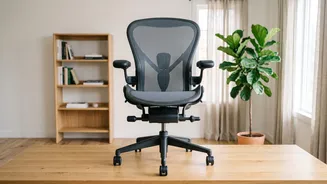
This movement counteracts the slouching posture that many of us adopt at our desks. Sit tall in your chair, ideally one with a back that ends mid-spine. Clasp your hands behind your head to support your neck. Gently lean back, allowing your upper back to arch over the top of the chair. Look forward, not up, to keep your neck in a neutral position. Hold for a few deep breaths, feeling the stretch across your chest and mid-back. This is an excellent way to open up the chest and thoracic spine.