


The Joy of Visiting
Bijoya Dashami marks the victory of Goddess Durga over the demon Mahishasur. For Bengalis, it also signifies the time when Durga, the daughter, returns to her husband's home in Kailash. The days that follow, stretching until Kali Puja or Diwali, are known
as the Bijoya period. It’s a time for renewing kinship with friends and family. Younger members touch the feet of elders to seek blessings, and homes are thrown open for guests to exchange 'Shubho Bijoya' greetings. Central to this tradition of visiting is the custom of hospitality. No guest can leave without being offered something to eat, a ritual fondly known as 'mukh mishti' or sweetening the mouth.
The Quintessential Snack Platter
While sweets are the highlight, the true star of the Bijoya spread is the platter that artfully balances sweet with savoury. These platters are a feast for the senses. Alongside an array of sweets like Narkel Naru (coconut ladoos), Sandesh, and Rasgulla, there is always a savoury counterpoint. This might include Ghugni (a dried pea curry), and a variety of fried delights. But amidst this delicious cornucopia, one item holds its ground as the undisputed champion, a snack that is simple, ubiquitous, and deeply loved: the Nimki.
Nimki: The Unquestionable Staple
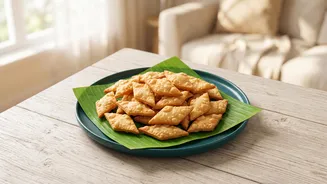
What exactly is Nimki? It's a deep-fried, savoury cracker made from a dough of all-purpose flour (maida), salt, and fat, often flavoured with kalonji (nigella seeds) and sometimes cumin. Its beauty lies in its simplicity and its addictive, crunchy texture. Nimkis come in various shapes and sizes. The most common festive version is the 'trikon' or triangular Nimki, which is folded into layered triangles before frying, resulting in a wonderfully flaky bite. There is also the 'kucho' nimki, which are smaller, diamond-shaped versions perfect for munching. Regardless of its shape, its salty, savoury profile is the perfect foil to the rich sweetness of the traditional Bengali desserts it is served with.
More Than Just a Snack
So, why has this humble snack become such an enduring staple of Bijoya celebrations? The reasons are both practical and emotional. From a practical standpoint, Nimki is the ideal festive food. It has a long shelf life and can be made in large batches well in advance of the visiting season, storing perfectly in airtight containers. This allows hosts to be ever-ready for the stream of guests that drop by. Its ingredients are simple and pantry-friendly, making it an accessible snack for everyone to prepare. Emotionally, Nimki is woven into the very fabric of Bengali nostalgia. It's the taste of 'adda' (long, leisurely conversations), the perfect companion to a cup of tea, and the flavour of homecoming. The act of making Nimki is often a cherished family activity, with recipes and techniques passed down through generations, each family having its own subtle variation.
A Legacy in Every Flaky Layer
The process of making the layered triangular Nimki is an art in itself. A special paste of flour and ghee, called 'sata', is often spread on the rolled-out dough before it is folded. This is what creates the distinct, flaky layers that separate upon frying, giving the Nimki its characteristic crunch. This layering technique transforms a simple dough into something special, much like how the festival itself adds layers of meaning to everyday life. The sound of a crisp Nimki breaking is the sound of togetherness, a flavour that connects generations. While many snacks come and go, Nimki's place on the Bijoya platter remains secure. It is more than just flour and salt; it's a taste of tradition, a symbol of welcome, and the crunchy, savoury soul of the celebration.