



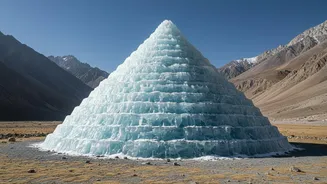
A Land of Thirst and Ice
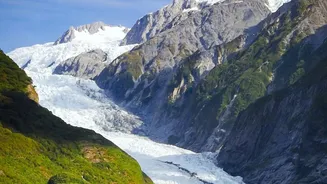
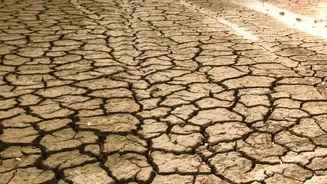
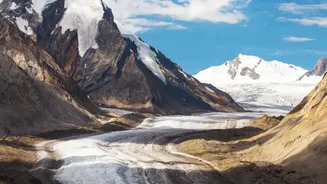
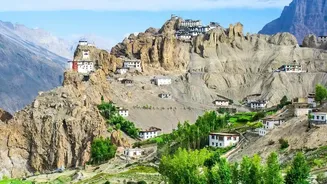
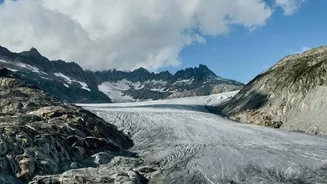
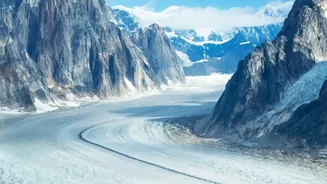
Ladakh, a cold desert nestled high in the Himalayas, faces a peculiar paradox. With annual rainfall of less than 50 millimetres, its communities and agriculture are almost entirely dependent on the seasonal meltwater from glaciers. For centuries, farmers
timed their planting schedules to this flow. But climate change has broken this ancient rhythm. Glaciers are retreating at an alarming rate, and winter snowpack is less predictable. The most critical problem is one of timing: the meltwater needed for sowing crops in April and May, when streams often run dry, now arrives in a sudden, flood-like rush later in the summer, long after it is most useful. This leaves farmers with a critical water shortage during the crucial spring planting season, threatening their livelihoods and food security.
The Birth of a Simple, Powerful Idea
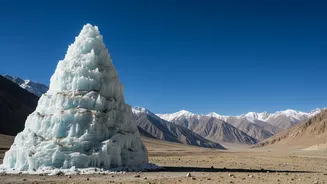
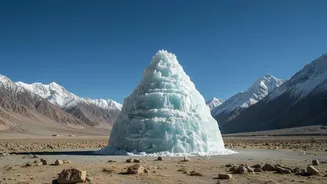
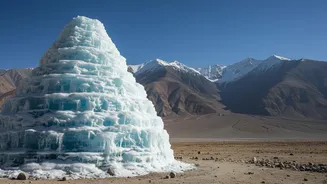
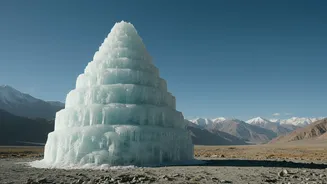
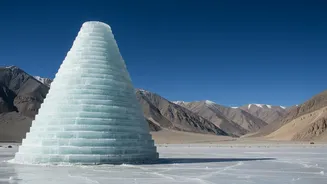
The solution came not from a complex, high-tech lab but from a local engineer and educator, Sonam Wangchuk. The inspiration was simple: Wangchuk noticed a patch of ice under a bridge that had survived late into the warm season, protected from the direct sun. He realized that the shape of a frozen mass was key to its longevity. While providing shade for entire glaciers was impossible, what if you could store winter water in a shape that shades itself? This led to the concept of the ice stupa, an artificial glacier shaped like a cone. The name is a deliberate nod to the traditional Buddhist monuments that are an integral part of the Ladakhi landscape, connecting the innovation to local culture.
Engineering an Artificial Glacier
The engineering behind an ice stupa is remarkably elegant and energy-efficient. In winter, when stream water is plentiful but otherwise unused, it is diverted through a pipeline from a higher altitude. Gravity provides all the necessary pressure, eliminating the need for pumps or electricity. The pipeline leads to the village, where it is directed upwards through a vertical pipe. As the water sprays out into the sub-zero winter air, it freezes almost instantly, falling and accumulating around a simple structural frame. Layer by layer, through the coldest months, a massive, conical tower of ice—an ice stupa—is formed. These structures can grow to be over 30 metres high and store millions of litres of water.
The Stupa's Geometric Secret
The genius of the ice stupa lies in its conical shape. Basic geometry dictates that a cone has the minimum possible surface area for a given volume. This is crucial when the sun gets stronger in the spring. By minimizing the area exposed to direct sunlight, the cone shape slows the melting process dramatically compared to a flat sheet of ice. The result is that the ice stupa holds onto its frozen water long into the spring. It begins to melt gradually in April and May, precisely when farmers need water for their newly planted barley, apple, and poplar saplings. Each stupa acts as a targeted, time-release water tower for the community it serves.
More Than Just Water
Since the first prototype was built in 2013, the ice stupa project has grown into a significant movement across Ladakh. Dozens of stupas have been built, providing water to irrigate barren land and enabling villagers to plant thousands of new trees. The impact goes beyond agriculture; it has become a powerful community-led initiative. Villages now hold competitions to see who can build the tallest stupa. The project, managed by organizations like the Himalayan Institute of Alternatives, Ladakh (HIAL), has become a symbol of positive climate adaptation. It demonstrates how local ingenuity can create effective, sustainable solutions, offering a model for other mountain regions facing similar water crises around the world.