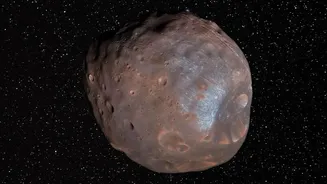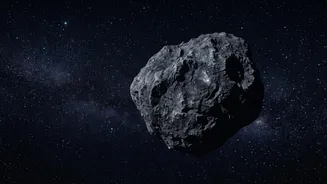

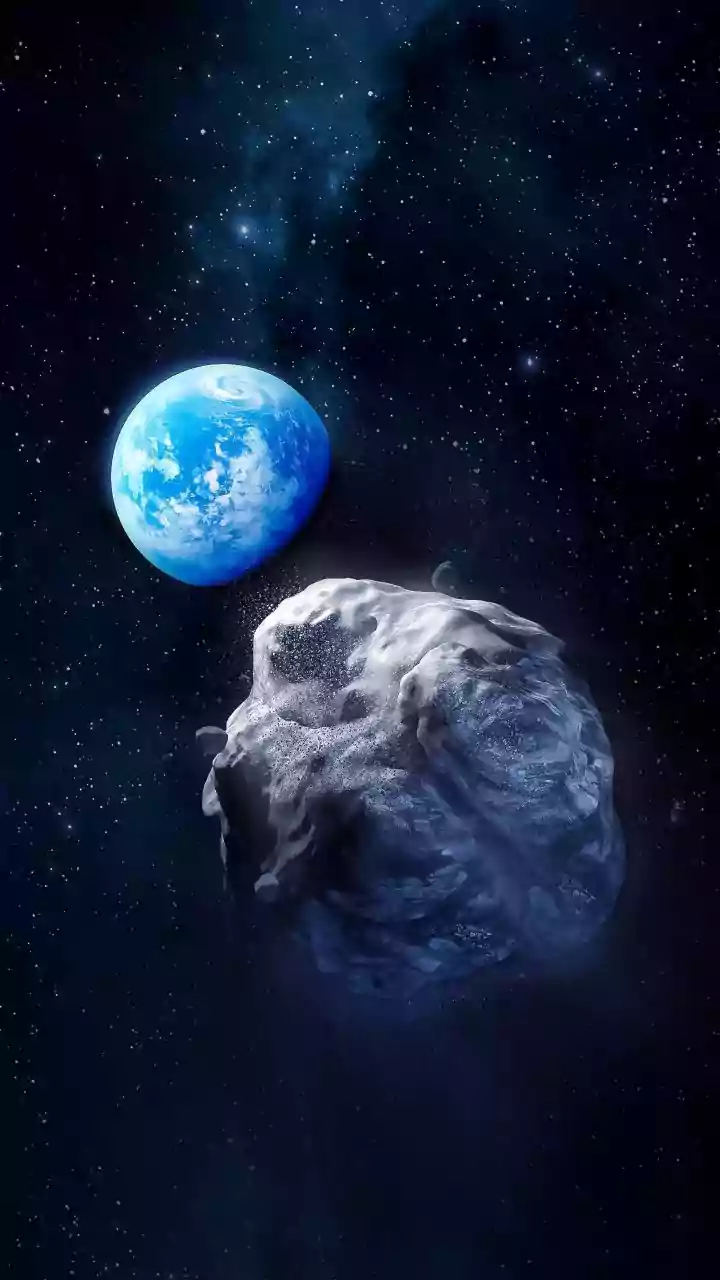
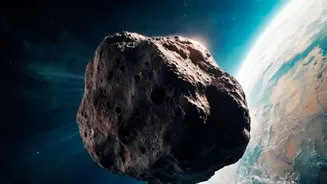
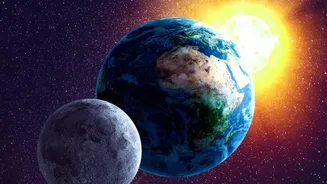
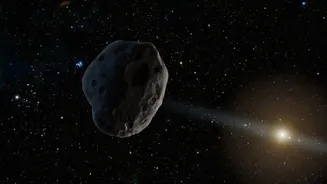
For the past several months, Earth has had a secret companion. A tiny asteroid, captured by our planet's gravity, has been acting as a second moon. But this cosmic visitor, 2026 QQ8, is about to say its goodbyes.
What is a 'Minimoon'?
Our solar system is a dynamic place, and
not everything is locked into a permanent celestial dance. A 'minimoon', or temporary satellite, is an asteroid or space rock that gets pulled into a planet's orbit for a short period. Unlike our large, permanent Moon, these visitors don't stay for long. Their capture is a delicate gravitational event, requiring the object to approach Earth at just the right speed and angle. If it's too fast, it will just fly by. If it's too slow or on a direct path, it could enter the atmosphere. But in the sweet spot, Earth's gravity can snag it, turning it into a temporary companion. Astronomers believe that at any given time, Earth likely has at least one of these small companions, though most are too small and faint to be detected.
The Brief Visit of 2026 QQ8
The story of 2026 QQ8 began in April 2026, when the small asteroid, estimated to be just one to two metres across, was gravitationally captured by Earth. However, due to its tiny size and dimness, it wasn't discovered until August by astronomers. Initially, there was uncertainty about its origin; it's common for scientists to first rule out the possibility that such an object is man-made space debris, like a defunct rocket stage. After follow-up observations, the Minor Planet Center officially catalogued it as a natural object in late October. Since its capture, 2026 QQ8 has been looping around our planet on a wide, unstable orbit, much farther out than our main Moon.
Why Our Second Moon Must Leave
The same gravitational forces that welcome a minimoon are the ones that eventually show it the door. The orbits of these temporary satellites are highly unstable and chaotic. They are influenced not only by Earth but also by the powerful gravitational pulls of our much larger, permanent Moon and the Sun. A close pass with the Moon can be enough to give the minimoon a gravitational nudge, flinging it out of Earth's orbit and back onto a path around the Sun. Sometime in early December, 2026 QQ8 will reach a point where it has enough velocity to escape Earth's gravitational influence and will once again become just another asteroid orbiting the Sun.
Hunting for Fleeting Visitors
Detecting minimoons is a significant challenge for astronomers. These objects are typically only a few metres in diameter, making them incredibly faint. They are also moving quickly relative to our viewpoint on Earth. Only a few have ever been confirmed, including 2006 RH120, which orbited Earth for about a year, and 2020 CD3, which stayed for nearly three years. These discoveries were made by dedicated sky surveys that repeatedly scan the night sky for moving objects, primarily to identify near-Earth asteroids that could pose a potential impact threat. While 2026 QQ8 poses no danger, and would likely burn up harmlessly in the atmosphere if it did enter, studying it and others like it is incredibly valuable. These objects are pristine relics from the early solar system, and understanding their composition can tell us a lot about how planets were formed.