



A Familiar Scene, A New Revelation
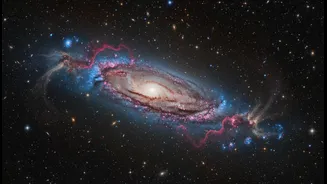
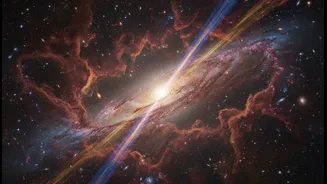
July 2026 marks the fourth anniversary of the James Webb Space Telescope's first science operations, a milestone NASA and its partners celebrated by releasing a breathtaking new view of Centaurus A. Located a relatively close 11 million light-years away,
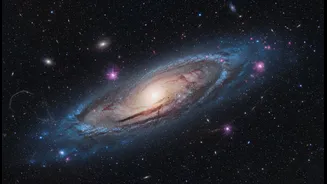
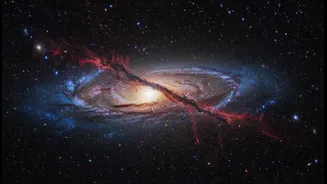
this galaxy is known for its peculiar shape, the result of a violent collision between two galaxies billions of years ago. While Hubble's visible light views were obscured by thick lanes of cosmic dust, Webb’s powerful infrared vision cuts through the haze, transforming a familiar galaxy into a far more complex and intricate structure than ever seen before. This new analysis reveals not just the aftermath of a cosmic crash, but the intricate interplay between a supermassive black hole and the galaxy it inhabits.
The Art of Galactic Archaeology
The headline of the new Centaurus A image is its strange, parallelogram-like structure and wisps of glowing dust, which have perplexed astronomers. But the real reward comes from the 'patient looking' the headline alludes to. The image is so detailed that what appears 'grainy' is actually a densely packed field of millions of individual stars. For astronomers, this is like being given a new form of cosmic Rosetta Stone. European Space Agency (ESA) astronomers have referred to the process as “galactic archaeology”. By studying the light, age, and location of these individual stars, scientists can reconstruct the galaxy's history: when bursts of star formation occurred, how the central black hole is feeding, and how it blasts out jets of energy that shape the material around it. This wasn't a discovery made in a single glance; it's the result of carefully analysing the immense dataset Webb provides.
A Gift That Keeps on Giving
This principle of re-discovery is not unique to Centaurus A. It is a core part of the JWST's mission. Webb's First Deep Field image of the galaxy cluster SMACS 0723, released in 2022, was a perfect example. The image used the cluster's immense gravity as a natural 'lens' to magnify even more distant galaxies behind it. At first, the world was stunned by the sheer number of galaxies revealed. But over time, patient analysis by scientists revealed faint, tiny structures that had never been seen before, including some of the most ancient star clusters ever found in a distant object nicknamed the 'Sparkler Galaxy'. These deeper finds came months and years after the initial image release, proving that the data is a treasure chest that scientists will be unpacking for decades.
More Than a Camera
It’s crucial to understand that JWST is not just a powerful camera but a versatile science machine. Beyond taking stunning pictures, its instruments perform spectroscopy, which is the analysis of light to determine the properties of an object. By studying the spectrum of light from Centaurus A, astronomers can measure how gas moves within the galaxy, revealing fast-moving outflows driven by the central black hole. This detailed information helps answer one of astronomy's biggest questions: how does a supermassive black hole influence its entire galaxy? It appears the relationship is complex, with the black hole both triggering star birth by compressing gas and stunting it by pushing material away. Each new look at the data provides another piece of this cosmic puzzle, rewarding the patient observer with a deeper understanding of the universe's mechanics.