






A New Map for Our Galactic Home
Imagine trying to map your city from your own house, without ever leaving. That's the challenge astronomers face when mapping our Milky Way. We are embedded within it, our view obscured by vast clouds of dust and gas. Yet, thanks to the European Space
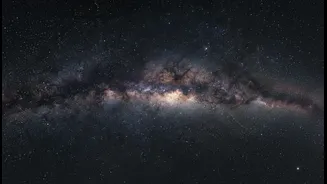
Agency's (ESA) Gaia space observatory, we now have an unprecedented guide. The mission's latest data release, anticipated for late 2026, builds upon years of painstaking observation to create a revolutionary catalogue of our galaxy. This isn't just another picture; it's a multi-dimensional census of billions of stars, charting their positions, movements, and properties with astonishing precision. The familiar swirl of the Milky Way we see in the night sky is now backed by a dataset so immense it is transforming nearly every branch of astrophysics.
More Than Just Dots of Light
A star's location is only the beginning of its story. The true power of this new catalogue lies in its depth. For a massive number of stars, Gaia provides not just a 3D position but also crucial information about their velocity—how they are moving through the galaxy. By measuring the light from each star, scientists can determine its brightness, temperature, and chemical composition. This is like knowing the make, model, and year of every car in the city, not just its parking spot. It allows astronomers to distinguish between young, hot stars and old, cool ones; to identify stellar families born from the same cosmic cloud; and to find rare and exotic objects like 'failed stars' known as brown dwarfs or binary star systems where two stars dance around each other. This level of detail helps to piece together the life story of individual stars and, in turn, the history of the galaxy itself.
The Technology of a Galactic Cartographer
The Gaia spacecraft, which concluded its science observations in early 2025, is an engineering marvel. Orbiting a stable point in space about 1.5 million kilometres from Earth, it has spent over a decade scanning the sky with its billion-pixel camera. To achieve its incredible accuracy, Gaia has measured the position of its target stars about 70 times each, on average. This repetition allows for the detection of the tiny wobbles and shifts that reveal a star's distance and motion. The volume of information collected is staggering, amounting to trillions of observations that must be processed into a coherent catalogue. The data-processing effort alone, involving a consortium of hundreds of scientists and engineers across Europe, represents one of the most complex computational challenges in modern science—a true 'big data' project on a cosmic scale.
Unlocking the Secrets of the Milky Way
With this wealth of information, astronomers can begin to tackle some of the biggest questions about our universe. The precise movements of billions of stars can be used to trace the gravitational influence of dark matter, the mysterious substance that makes up most of the galaxy's mass but remains invisible. By 'rewinding' the motions of stars, scientists can reconstruct the Milky Way's turbulent history of colliding with and absorbing smaller galaxies over billions of years. The catalogue is also a powerful tool for discovering new worlds. By detecting the slight dimming of a star as a planet passes in front of it or the tiny gravitational wobble a planet induces on its star, the data can reveal thousands of new exoplanets. Every corner of astronomy, from studies of asteroids in our own solar system to the structure of the cosmic distance ladder, is being enhanced by this data.