






First, What is Thrust?
At its core, thrust is the force that pushes a rocket upward. Think of it as Newton's Third Law in spectacular action: for every action, there is an equal and opposite reaction. A rocket expels a massive amount of hot gas downwards (the action), which
generates an upward force (the reaction), pushing the rocket towards space. The more powerfully it can expel those gases, the greater the thrust. This force must be strong enough to overcome Earth's gravity and lift the vehicle's own enormous weight, which is mostly propellant.
Why the Quest for More Power?
The demand for higher thrust is driven by ambition. To launch heavier satellites for communication or defence, send probes to Mars or Venus, and build the Bharatiya Antariksh Station by 2035, India needs rockets with more muscle. Greater thrust allows a launch vehicle to carry heavier payloads into orbit, making each launch more economically efficient. It's the key that unlocks the ability to compete for lucrative international launch contracts and undertake complex scientific missions that are currently beyond the capacity of existing rockets like the PSLV and LVM3. It also underpins the development of reusable launch vehicles, which are critical for reducing the cost of accessing space.
The Technology Behind the Power: Engine Types
Achieving higher thrust is a complex engineering challenge that boils down to the rocket engine. India has already mastered cryogenic engines, like the CE-20 that powers the upper stage of the LVM3 rocket, which use super-cooled liquid hydrogen and liquid oxygen. The next big leap is the semi-cryogenic engine. This design uses liquid oxygen as an oxidizer but replaces liquid hydrogen with a refined, room-temperature kerosene. This propellant is denser, easier to handle, and allows for a more powerful and efficient engine. Looking further ahead, many global players are focused on methane-liquid oxygen (methalox) engines, which burn cleaner and are considered ideal for reusability.
India's High-Thrust Engine: The SCE-200
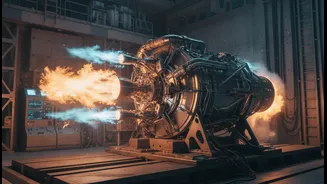
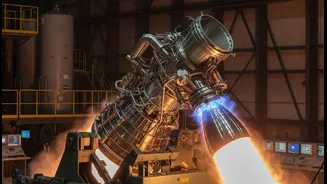
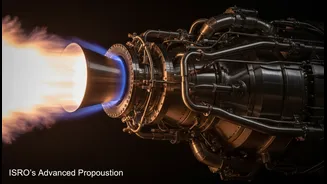
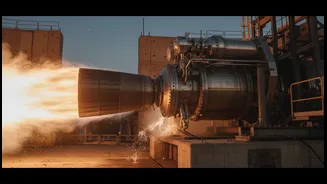
India's answer to the high-thrust challenge is the SCE-200, a powerful semi-cryogenic engine being developed by the Indian Space Research Organisation (ISRO). This engine is designed to produce 2000 kilonewtons (or about 200 tonnes) of thrust. The SCE-200 is the heart of ISRO's future launch vehicle strategy. In late June 2026, ISRO successfully conducted a hot test of the engine's power head, achieving a thrust level of 175 tonnes, or 88% of its target. This was a major milestone, demonstrating the stability and performance of the engine's critical components and paving the way for a full-thrust demonstration. The successful development of this engine is crucial for India's space program.
Powering the Future: The NGLV
The SCE-200 engine is not just an upgrade; it's the foundation for a whole new rocket family: the Next Generation Launch Vehicle (NGLV). Also known as 'Soorya', the NGLV is designed to be a cost-efficient, partially reusable, heavy-lift vehicle that will eventually replace the entire fleet of PSLV, GSLV, and LVM3 rockets. The plan is to use the powerful semi-cryogenic engine for the booster stages of the NGLV, significantly increasing its payload capacity to 10 tonnes to Geostationary Transfer Orbit. This vehicle will be instrumental in launching components for India's space station and enabling future crewed missions to the Moon by 2040. ISRO is also developing methalox engines for potential use in the NGLV's upper stages, showcasing a forward-looking approach to green and reusable technologies.