



What Is Space Weather?
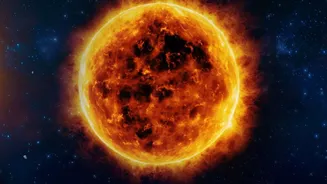
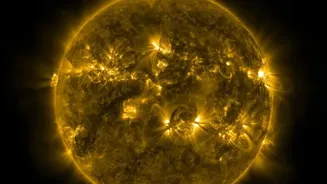
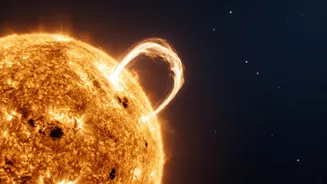
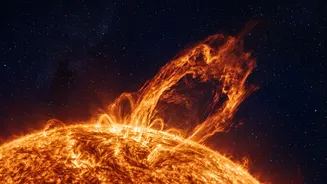
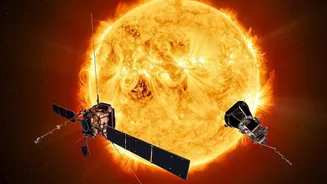
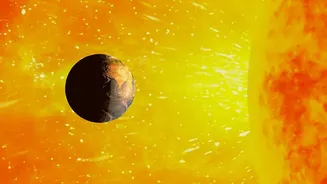
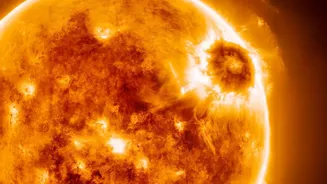
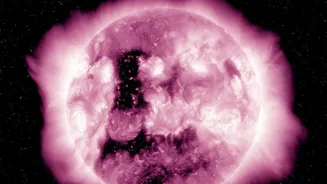
Space weather refers to the changing conditions in space, primarily driven by the Sun's activity. Think of it like weather on Earth, but instead of wind and rain, it involves a constant stream of charged particles called the solar wind. Sometimes, the Sun releases
huge, sudden bursts of energy and particles, known as solar flares and coronal mass ejections (CMEs). When these eruptions are aimed at Earth, they can interact with our planet's magnetic field and atmosphere, causing significant disruptions to the technology we rely on every day.
The Challenge of Forecasting a Solar Storm
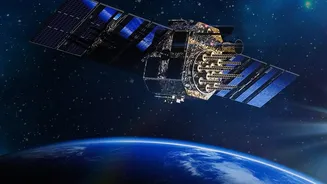
For years, predicting when and where a solar storm will impact Earth has been a major challenge. Previous models often provided warnings that were either not timely or not specific enough to be truly useful. This left satellite operators and power grid managers with very little time to take protective measures. A powerful solar storm can induce currents in power lines, potentially damaging transformers and causing widespread blackouts. They can also harm satellites, affecting everything from GPS navigation and communication to weather forecasting. Without a reliable warning system, our increasingly connected world remains vulnerable.
How AI Changes the Game
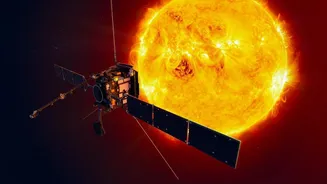
NASA, in collaboration with international researchers, has developed a groundbreaking AI model called DAGGER (Deep Learning Geomagnetic Perturbation). This system represents a major leap forward in space weather forecasting. Instead of relying on older, slower methods, DAGGER uses artificial intelligence to analyze real-time data from spacecraft that monitor the solar wind. It was trained on vast amounts of historical data from past solar storms, allowing it to learn the subtle patterns that precede a major event. This deep learning approach enables it to make predictions with unprecedented speed and accuracy.
A Critical 30-Minute Warning
The most significant advantage of the DAGGER model is its ability to provide a reliable, location-specific forecast of a solar storm's impact 30 minutes before it happens. This might not sound like much time, but in the world of infrastructure management, it's a game-changer. That half-hour warning gives power grid operators a chance to re-route power or take transformers offline to prevent damage. Satellite operators can put their spacecraft into a protective 'safe mode' to shield sensitive electronics from harmful radiation. This moves us from simply reacting to damage to proactively preventing it.
Why This Matters for India
For a nation as digitally integrated as India, this technology is critically important. Our reliance on satellites for communication, navigation, and broadcasting is immense. A major solar storm could disrupt GPS services that are essential for logistics and ride-sharing apps, interfere with TV signals, and compromise banking networks that depend on satellite timings. Furthermore, as India's power grid becomes more interconnected, it also becomes more susceptible to the kind of geomagnetically induced currents that solar storms can create. An early warning system like DAGGER, whose lead author is from the Inter-University Center for Astronomy and Astrophysics in India, provides a vital layer of defence for our national infrastructure.